
From Faro to Mantua to London
The Odyssey of Portugal’s First Printed Book
The Faro Pentateuch of 1487
By Shlomo Pereira1
Abstract
The Faro Pentateuch, the first book printed in Portugal in 1487, survives in a single copy held by the British Library. This study offers a comprehensive examination of the incunabulum itself, its format, type design, vocalization practices, masoretic apparatus, colophon, and material features, situating the edition within the short but intense history of Hebrew printing in late fifteenth century Portugal. In addition, it examines the documentary provenance inscribed within the only surviving copy, tracing ownership from sixteenth-century Jewish hands in Mantua through the renowned collection of Joseph Almanzi of Padua, and finally to the British Museum's acquisition in the 1860s. In this context, the article considers the claim that this copy of the Faro Pentateuch formed part of the spoils taken from Bishop Mascarenhas’s library during the English raid on Faro in 1596. While the looting of the library is a well-documented fact, the link between this copy of the Faro Pentateuch and this event is decisively refuted by textual and archival evidence.
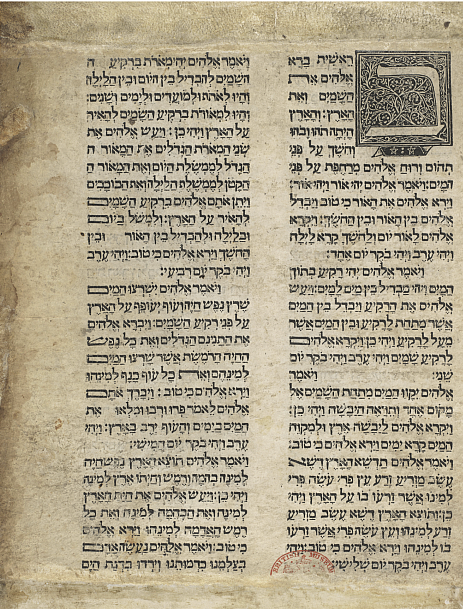
First page of the Book of Genesis, Faro Pentateuch, Daro, 1487.
The British Library, London, United Kingdom.
1. Introduction
The history of the printed book in Portugal begins not with a work in Portuguese or Latin, but with a Hebrew Pentateuch produced by the Jewish printer Don Samuel Gacon in the southern city of Faro and concluded on June 30, 1487. This remarkable fact, that Portugal’s first typographical product emerged from a Jewish press, situates the Faro Pentateuch at the intersection of several important historiographical currents: the diffusion of Gutenberg’s technology across Iberia, the cultural vitality of late‑medieval Sephardic communities, and the catastrophic disruptions of the expulsion edicts that would follow within a decade.2
Only a single copy of this incunabulum has survived to the present day, preserved in the British Library in London. The extreme rarity of the edition invests questions of textual and material description and questions of provenance with particular relevance. This one volume is our sole witness to the typographical, codicological, and editorial decisions that shaped the first Portuguese imprint.3
The Faro Pentateuch presents the Hebrew text of the Torah in a carefully planned format, one hundred and ten leaves in two columns, with vocalization but without cantillation marks, printed on parchment rather than paper and employing locally cut Hebrew types whose distinctive features have no exact parallels in contemporary Iberian or Italian presses. As a material object, the book thus offers a unique window onto the technological, halachic, and aesthetic horizons of late fifteenth-century Sephardic printing.
At the same time, the contemporary political debate concerning cultural property looted from Faro during the 1596 English military raid has given the Faro Pentateuch a new public profile. Civic and cultural actors in Faro have advocated for the repatriation of books taken from the private library of Bishop Fernando Martins Mascarenhas and transferred to the Bodleian Library at Oxford.4 In this context the British Library copy of the Faro Pentateuch has been drawn into the orbit of these claims and its path amalgamated with the private library of Bishop Mascarenhas and the English raid.5
This article, therefore, pursues a double aim. First, it offers a detailed description of the Faro Pentateuch as an incunabulum examining its format, types, vocalization system, paratextual features, and colophon, while situating these within the broader landscape of Hebrew printing in Portugal between 1487 and 1496. Second, it reconstructs the documented chain of ownership of the surviving copy prior to its acquisition by the British Museum and uses this evidence to assess the alternative theory linking the book to the Essex raid and the library of Bishop Mascarenhas. In doing so, the article seeks both to clarify the historical record regarding this copy and to contribute to a wider understanding of the paths of early Hebrew incunabula.
2. The Faro Pentateuch
2.1 The Faro Pentateuch in the context of Hebrew printing in Portugal6
Hebrew printing in Portugal, introduced from Spain in the late 1480s, predates both Latin and vernacular Portuguese printing. The earliest typographical products of the country were Hebrew books, a circumstance that reflects the intellectual sophistication and economic resources of Portugal's Jewish communities in their final decades.
Portuguese Jewish printing workshops are known to have operated in three cities with a known output of sixteen incunabula: Faro, with three incunabula, one in 1487 and two around 14917; Lisbon, which yielded eight incunabula between 1489 and 1492; and Leiria, where four Hebrew incunabula plus one in vernacular, appeared between 1492 and 1496.8 In total, half of the approximately thirty incunabula printed in Portugal were Hebrew editions.
The first dated Portuguese imprint of any kind is the Faro Pentateuch of 1487. It was followed in 1489 by the printing of the Commentary on the Torah by Nachmanides in Lisbon. The Tratado de Confissom printed in Chaves later in 1489, is recognized as the first incunabulum printed in the Portuguese language. The significance of the Faro Pentateuch thus extends beyond Jewish cultural history. It marks the very beginning of Portuguese typographical history.
The printing of the Faro Pentateuch was completed on the 30th of June of 1487 in the printing shop of Don Shmuel Gacon. The text is set in square Hebrew type and is vocalized, that is, it includes the vowel points that facilitate reading of the consonantal Hebrew script. Don Shmuel Gacon's printing operation in Faro went on to produce other works, including two Talmudic tractates of which only fragments survive today.9
On December 5, 1496, King Manuel I of Portugal signed the decree ordering the expulsion of the Jews to take effect by the end of October 1497. In practice, the edict rather than leading to the expulsion of the Jews soon morphed into the eradication of Judaism through the systematic dismantling of the Jewish community and a series of episodes of wholesale forced conversions.10
The expulsion brought Hebrew printing in Portugal to an abrupt end.11 The books produced in the brief decade of Portuguese Hebrew typography, 1487 to 1496, thus represent both a pinnacle of cultural achievement and a poignant coda to centuries of Jewish life on the Iberian Peninsula.
2.2 General characteristics of the incunabulum
The Faro Pentateuch presents the Hebrew text of the Torah in one hundred and ten leaves of 27.0 cm by 20.5 cm, with two columns of thirty-two lines, except for the first five leaves which have only thirty lines.
The reason for this discrepancy in number of lines is because, as was common in Italy and Spain, the printers intended to include Masoretic notes along with the text of the Pentateuch. These notes were included in the first five leaves, but then, the printers decided not to pursue this task, and so, these five leaves are two lines shorter. Indeed, the tops and the bottoms of these five leaves show signs that they were cut and show vestiges of some of the letters of the glosses.
The text of the Faro Pentateuch is presented in square letters, including vowels and punctuation marks, but it does not include cantillation marks. The technique necessary for adding vowels to the Hebrew letters had only recently been introduced in Italy in 1482, and the Faro Pentateuch is the earlier example in the Iberian Peninsula of vocalization of a Hebrew printed text.
A notable feature of the copy of the Faro Pentateuch in the British Library is that it is printed on parchment. This fact shows an important continuity with the use of parchment in the manuscript versions, particularly the ones used for ritual purposes, as mandated by Jewish law and tradition. Naturally, since this is the only surviving copy of the incunabulum, we do not know if copies were also printed on paper.12
The character types used in this printing seem to have been manufactured locally in Faro, as they have some unique characteristics. Among these characteristics are merged letters alef and lamed and several letters with stretched versions, such as the letters reish, shin and tav, a device used for double justification of the text. There is also the complete absence of the dagesh, a dot used in the middle of some specific letters, which presented natural technical difficulties. In addition, there is a more intriguing absence of the makef, a dash in between two joint words. Finally, there is a spotty use of the dot when the letter shin is to be pronounced sin.
As to the decorative elements, the first letter of the Book of Genesis, bet, is printed in a large type in white on a beautifully decorated black backdrop. This is absent in the beginning of the other four books. In addition, and in a smaller print, there are some Masoretic notes at the end of the Book of Genesis.
In addition, in the normal size print but without vowels, at the end of the Book of Exodus there is an exhortation “chizuk v’imzu” [Be strong and courageous] (Deuteronomy 31.6) and, at the end of the Book of Numbers, “chazak v’nitchazak” [Be strong and let us strengthen ourselves] (2 Shmuel 10.12).
In terms of its contents, the text of the Faro Pentateuch follows very closely the Masoretic text. A few differences have been found, including abbreviated words in the Book of Genesis, a spelling mistake and four words missing in the Book of Exodus, one omitted word in the Book of Leviticus and a misplaced word in the Book of Numbers.
Finally, the printed text does not include any sign as to the delimitations of the twenty-three Torah portions in the Book of Genesis and the Book of Exodus. It includes, however, although with a couple of exceptions, delimitations of the thirty-one portions in the remaining three books.
2.3 On the colophon of the Faro Pentateuch
The colophon of the Faro Pentateuch provides details about the date, the location, and the person responsible for printing:
“Concluded here in Faro on the 9th of the month of Tammuz, in the year of ‘praise the righteous for he is good’ by order of the noble and elevated Don Shmuel Gacon may G-d protect him.”
In the colophon, the sentence “praise the righteous for he is good” is a biblical quote from Isaiah 3.10. The first word, imru, is spelled in Hebrew with alef mem reish vav, and has the numerical value of 247 with the millennium implicit, identifies the Hebrew year as 5247. As such, the printing of the Faro Pentateuch was completed on the 9th of Tammuz of 5247, or June 30, 1487, in the Julian calendar.
It is important to note that the completion date written down in the colophon falls on Shabbat, which raises interesting questions. In the second half of the 16th century, it is well documented that many Hebrew religious books were dated as having been completed on Shabbat. This would be something that, if taken literally, Jewish Law would prohibit.
In such cases, two situations explain the date of conclusion being a Shabbat. In some cases, the printing was completed on Friday, but the date of Shabbat is recorded to give extra honor to the occasion. In other cases, the work was indeed completed on Shabbat, often Friday evening, having been performed by non-Jewish printers working under contract and wishing to finish their tasks as soon as possible. Although permissible, this second situation was undesirable because it did not allow the Jewish editors proper time to proofread the printed versions of the Hebrew texts before the full printing run.13
Another interesting aspect of this colophon is that in Hebrew the name Gacon is spelled with the letter gimmel modified by a geresh, an apostrophe on the left of the letter. This is used to modify the sound of the letter gimmel from a hard g, as in the word ‘garden’ to a soft g, as in the word ‘gentle,’ a sound that does not exist in Hebrew. This suggests that the pronunciation of the name Gacon with a hard g sound, as usually assumed, may not be correct.
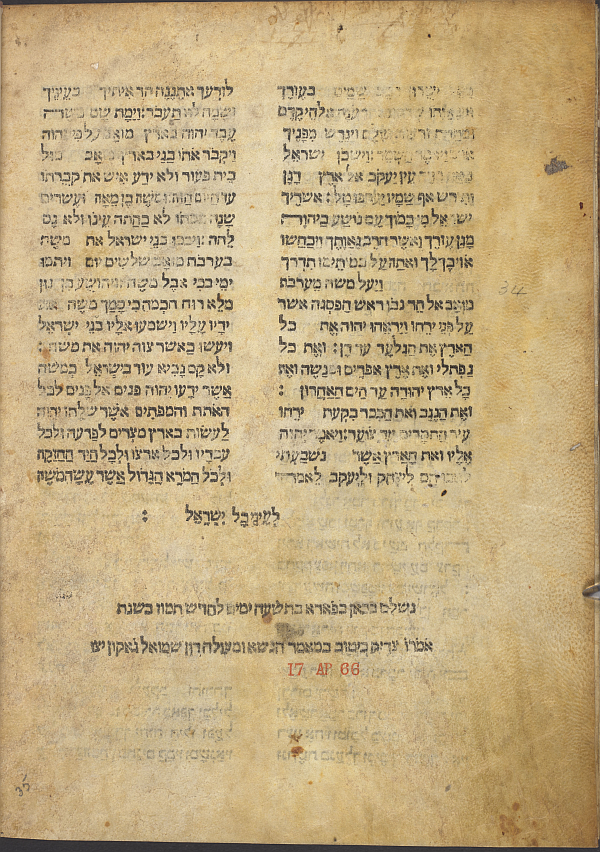
Last page with colophon, Faro Pentateuch, Faro, 1487.
The British Library, London, United Kingdom.
3. On the Provenance of the Only Surviving Copy of the Faro Pentateuch
Much can be learned from examining the notes written in an extant incunabulum about its provenance. In the case of the Faro Pentateuch, a comprehensive provenance analysis was performed by the experts of the British Library.14
3.1 Manuscript ownership notes: Mantua, late 15th and 16th centuries
The sole surviving copy of the Faro Pentateuch, now in the British Library, carries manuscript annotations that document its chain of ownership. As mentioned before, the Faro Pentateuch was completed in June 1487, which provides an anchor point for reconstructing the volume’s early history. These inscriptions prove that until approximately 1600, the book was in the possession of Jewish owners in Mantua, Italy. The earliest identifiable owner is R. Nissim of Mantua. At least two other earlier anonymous Jewish owners are also attested through inscriptions in the volume.
Within a relatively short time after its completion, sometime between 1487 and 1500, this copy of the Faro Pentateuch was in the hands of an anonymous Ashkenazic owner, probably in northern Italy, whose scattered marginal notes and remnants of current titles in an early Italian‑Ashkenazic script attest to active use in the late fifteenth century.
At a subsequent stage, likely in the early sixteenth century as the book circulated within the Italian book trade, it entered the possession of R. Nissim of Mantua, whose name appears in an inscription explicitly linking him and the city of Mantua with the book, indicating that by then the Faro Pentateuch had reached the Jewish community of Mantua.
Finally, most plausibly later in the sixteenth century, an otherwise anonymous buyer acquired the volume from “the esteemed R. Nissim of Mantua” and noted on the front paste‑down that he purchased it from him for twenty‑two francs, preserving both the identity of the bookseller and the approximate economic terms of this transition from commercial stock to private ownership.
The Italian provenance is entirely consistent with the broader pattern of book dispersal after the Iberian events of the late 15th century. When the Jews of Spain were expelled in 1492, and those in Portugal were forcibly converted in 1497, many fled bringing their books with them to Italy, where they found refuge in communities across the peninsula, Venice, Mantua, Ferrara, Pesaro, and elsewhere.15 A Hebrew Pentateuch printed in Faro in 1487 that surfaces in Mantua by the sixteenth century follows a trajectory well attested for Sephardic books of this period.
3.2 Who was the “esteemed R. Nissim of Mantua”?
Who was R. Nissim of Mantua? The fact is that we do not know for certain. What we do know is that the only clearly documented rabbi named “R. Nissim” active in sixteenth‑century Mantua is R. Nissim Yitzchak ben Yehudah Sforno.16 R. Nissim was a sixteenth-century rabbi of Mantua and a member of the distinguished Italian Sforno family, many of whose members were prominent rabbis, scholars, and communal figures. His patronymic places him in the broader kin network that included the famous exegete and philosopher R. Obadiah ben Yaakov Sforno (1475-1549) of Cesena and Bologna, as well as other rabbinic Sfornos active in Bologna, Viadana, Venice, and Mantua.
The family’s profile, combining rabbinic learning, communal leadership, and in some cases financial activity, suggests that R. Nissim grew up in an environment closely tied to both Torah scholarship and the educated, well-connected strata of Italian Jewry. His recorded literary activity is modest but telling. He is known as the author of an epistle on R. Yehudah HaLevi’s Kuzari, and at least one of his halachic responsa is preserved in a manuscript collection of Italian responsa from that period. The known information about R. Nissim Sforno places him squarely within the learned and affluent rabbinic elite of Mantua and therefore as a plausible candidate for being the “esteemed R. Nissim of Mantua “.
3.3 The Almanzi collection
After the period documented by the Mantua ownership inscriptions, the next traceable owner of the Faro Pentateuch is Giuseppe Almanzi (1801–1860), an Italian Jewish poet and bibliophile from Padua.17 Born into a wealthy merchant family, Almanzi devoted his life to assembling a library of extraordinary breadth and rarity, which become one of the most important privately held collections of Hebrew books and manuscripts at the time.
After Almanzi’s death in 1860 in Trieste, his heirs published a catalogue of the collection compiled by his lifelong friend Samuel David Luzzatto (1800-1865), an Italian and Austrian Jewish scholar and poet, under the title Yad Yosef (Padua, 1864).18 The catalogue describes the collection as it stood in the family library shortly after his death. The Faro Pentateuch is entry 318 of this catalog and identified as the only copy of this incunabulum known to exist.
3.4 A tantalizing possibility: was the Faro Pentateuch part of the CHIDA collection?
Giuseppe Almanzi’s library rested on a large nucleus inherited from his father, Baruch Chaim Almanzi. Baruch Almanzi had bought the book collection of R. Chaim Yosef David Azulai (1724–1806), also known as the CHIDA, from the latter’s son in Ancona, and then passed it on to Giuseppe at his death in 1837. In turn while Giuseppe was already an avid book collector before 1837 all the evidence is his most important additions to the collection were made after he inherited the CHIDA collection.
This raises the unresolved question of whether the unique Faro Pentateuch, later singled out as “the rarest piece” among the fourteen Hebrew incunabula on vellum bought from the Almanzi printed collection, entered Almanzi’s possession already as part of the CHIDA library Giuseppe inherited, or whether he bought it himself later.
The CHIDA was unquestionably one of the most distinguished Sephardic rabbis of the 18th century and a significant aspect of his travels was his systematic examination of Hebrew manuscripts and rare books in libraries across Europe. This was a considerable research endeavor that would later inform his major bibliographical work, Shem HaGedolim [Names of the Sages]. The CHIDA visited printing presses, private collections, and major libraries, including the Royal Library in Paris, where he marveled at the extensive collection of Jewish books.
The chronology does not exclude CHIDA as a possible source: his well-documented travels through Italy, including a recorded presence in Mantua and nearby centers in the 1750s–1770s, fall squarely within the period in which itinerant rabbinic emissaries actively collected books and manuscripts, so in principle a Portuguese incunabulum like the Faro Pentateuch could have reached him via Italian dealers or private owners.
At the same time, there is no explicit indication in CHIDA’s writings, whether in the chronicles of his travels Ma‘agal Tov [Good Circle] or in the bibliographical notices of Shem HaGedolim, that he ever acquired this particular Faro Pentateuch, nor do modern attempts to reconstruct his holdings produce a demonstrable list of his incunabula, while stressing instead that the core of his collection consisted of Kabbalistic and Italian rabbinic works.
In light of the absence of any direct reference to the Faro Pentateuch in CHIDA’s works, the heavily Kabbalistic profile of his library, and the strong evidence that Almanzi himself vigorously expanded the inherited CHIDA nucleus, particularly in the field of high-end vellum incunabula, the most likely scenario is that the Faro Pentateuch was not part of the original CHIDA collection, but rather a later, discerning acquisition by Giuseppe Almanzi himself, somewhere between 1838 and 1852.19
3.5 Acquisition by the British Museum
Following Giuseppe Almanzi's death, his manuscript and book collection was dispersed. 322 manuscripts were purchased by the Trustees of the British Museum in 1865 through the firm Asher & Co. of Berlin. This acquisition represented one of the most significant additions to the Museum's Hebrew holdings, transforming the Museum's standing among the world's Hebrew manuscript repositories.20
The printed books from the Almanzi collection took a different path, passing first to the bookselling firm of Asher & Co. in Berlin, and the renaming items to the book-dealer Frederik Müller in Amsterdam.21
In 1865, the Trustees of the British Museum bought fourteen Hebrew incunabula, all in parchment, from the Almanzi printed book collection also through Asher & Co. and took possession of the books in 1868. The Faro Pentateuch was among these acquisitions, and identified as an exceedingly rare piece, the most important of the incunabula in this purchase.22
The rest of the Almanzi printed book collection was bought in 1872 by the trustees of Temple Emanuel in New York from Frederik Müller. In 1892, Temple Emanuel presented this collection to the library of Columbia University, where it remains today. This donation is widely regarded as the step that transformed Columbia’s Judaica holdings into a genuinely major collection.23
4. An Alternative Theory: The Essex Raid and Bishop Mascarenhas's Library
4.1 The spoils of the 1596 raid of Faro and the donation to the Bodleian Library
In July 1596, a combined Anglo-Dutch naval expedition under the joint command of the Earl of Essex and Lord Howard of Effingham raided the southern Iberian coast. After a devastating attack on Cadiz in early July, the fleet continued to the Algarve, where English forces disembarked near Faro on July 23.24 Finding the city evacuated, the invaders sacked and burned Faro over the course of four days before re-embarking on July 27.25
Among the spoils taken by Essex was the personal library of Fernando Martins Mascarenhas. Mascarenhas was appointed Bishop of Faro in 1594/1595 and served in that capacity until 1616, when he became Inquisitor General of Portugal until his death in 1628.26 The bishop himself was not in Faro at the time of the raid, having left with his troops for Lagos, and his account of the devastation, written eight years later, is based on the reports of others.
Upon his return to England, Essex stored the looted books in one of his residences. In 1600, he donated a large part of them to Thomas Bodley, who was then refurbishing the library at Oxford University. The donation included 176 titles in 215 volumes. Of these, 65 titles in 91 volumes bear the armorial stamp of Bishop Mascarenhas in gold on their covers and can be securely identified as having come from his personal library.27 These books remain in the Bodleian Library to this day.
The records of the Essex donation have been published and studied by multiple scholars over four centuries. The Bodleian's own Benefactors' Book and a list published in 1922 in The Bodleian Quarterly Record provide a comprehensive accounting of the donated volumes.28 The 91 volumes identifiable as Mascarenhas's property are uniformly Latin theological and legal texts. Critically, the extensive records of this donation have no reference to Hebrew-language material.29
4.2 Was the Faro Pentateuch looted from the library of Bishop Mascarenhas?
The claim that the surviving copy of the Faro Pentateuch was among the books stolen from Bishop Mascarenhas in 1596 fails on multiple grounds. First, the documentary evidence inscribed in the incunabulum itself places the book in Jewish hands in Mantua, Italy, during the very period it would allegedly have been in the bishop's library in Faro. Second, the Faro Pentateuch is in the British Library in London, not the Bodleian Library at Oxford University. The books from the Essex raid were donated to the Bodleian Library at Oxford University, not to the British Library in London. In fact, the Faro Pentateuch is named explicitly as part of the Almanzi collection in an 1852 publication by the Bodleian Library.30 The British Library bought the Faro Pentateuch through an entirely separate channel, the commercial dispersal of the Almanzi collection in the 1860s.
This broader provenance narrative documented above is internally consistent and requires no speculative leaps. A Hebrew book printed in Faro in 1487, carried to Italy by Jewish refugees after 1497, passing through Jewish scholarly circles in Mantua, entering the collection of a Jewish bibliophile in Padua in the nineteenth century, and finally acquired by a major European research library in the 1860s, this is a thoroughly unremarkable trajectory for a Sephardic incunabulum. The alternative theory, by contrast, requires one to disregard the manuscript evidence within the book, conflate two separate English institutional collections, and posit the presence of a Hebrew book in a Catholic bishop's personal library without any supporting evidence.
4.3 On the likelihood of a Hebrew book in a Portuguese bishop's library
Any scenario that places a Hebrew book in the possession of a Portuguese bishop in the late sixteenth century must reckon with the particular history of Hebrew books on Portuguese soil. The forced conversions of 1497 were accompanied by a systematic, crown-directed campaign to confiscate all Hebrew religious texts from the newly baptized population.
Contemporaneous Jewish sources attest to the scope and severity of this campaign. Rabbi Abraham Sabba recorded that near Lisbon the mere possession of a Hebrew book had become a capital offense, and that he was imprisoned for six months after attempting to recover manuscripts he had buried.31 The chronicler Elijah Capsali noted that King Manuel appointed agents specifically to search out and seize every Hebrew book in the kingdom.32 The confiscated volumes were variously destroyed, sold into commercial channels, or carried abroad by the few who managed to leave; the net effect was the near-total disappearance of Hebrew texts from Portugal within a few years.33
The Portuguese Inquisition, formally established in 1536, deepened this erasure. Inquisitorial tribunals treated the discovery of hidden Hebrew books as damning evidence of judaizing practice among the New-Christian and trial records from Lisbon, Évora, and Coimbra repeatedly document prosecutions triggered by the possession of even fragmentary Hebrew texts.34 In this environment, a Hebrew book in Portugal was not a neutral cultural artifact; it was incriminating material, actively sought out, and punished. A senior churchman holding such an object would have been an anomaly requiring explanation.
It is true that elsewhere in Catholic Europe, particularly in Renaissance Italy, Hebrew incunabula, and manuscripts, including some of Portuguese origin, were widely found in the hands of clergy and Christian scholars or just clergy censors. In addition, Christian Hebraists in the Rhineland and England routinely acquired Hebrew books for philological and theological study.35 In every documented case, however, the clerical owner was an identifiable Hebraist or collector with a known scholarly program.
Portugal stood largely outside this tradition. The climate created by the forced conversions and the Inquisition attached suspicion rather than prestige to the study of Hebrew, and no Portuguese bishop of the period is recorded as a Hebraist or a collector of oriental texts. Mascarenhas, whose identified books are uniformly Latin theological and legal works, and who rose to become Inquisitor General in 1616, conforms entirely to this pattern.36 The presence of a Hebrew Pentateuch in his library would thus have been highly implausible.
5. Concluding Remarks
The Faro Pentateuch of 1487 emerges from this study as both a foundational artifact of Portuguese typographical history and a richly layered witness to late medieval Sephardic book culture. Its format, locally cut Hebrew types, vocalization and Masoretic practices, parchment support, and colophon collectively illuminate the technical capacities and cultural ambitions of Don Samuel Gacon’s Faro press on the eve of the Portuguese expulsion. The book’s material features link it to broader developments in Iberian and Italian Hebrew printing while also marking it as a distinctively Portuguese production, anchored in the specific social and religious world of the Faro Jewish community.
The provenance of the sole surviving copy is documented with unusual clarity for a work of this antiquity. Manuscript ownership inscriptions show that by the sixteenth century the volume was in Jewish hands in Mantua, and that it later entered the library of Giuseppe Almanzi, whose collection of Hebrew books and manuscripts was among the most significant of the nineteenth century. The British Museum purchased the Faro Pentateuch in the 1860s, as part of a group of vellum Hebrew incunabula from the dispersed Almanzi printed book collection.
Against this well-supported trajectory, the theory that the Faro Pentateuch formed part of the spoils taken from Bishop Mascarenhas’s library during the 1596 Essex raid cannot be sustained. The inscriptional evidence places the book in Mantua precisely when it would have had to be in Faro for that scenario to hold, the volume resides in the British Library rather than in the Bodleian, and the published documentation of the Essex donation contains no trace of Hebrew books of any kind. While the raid unquestionably resulted in the violent dispersal of Mascarenhas’s Latin theological and legal collection, there is no documentary basis for extending that history to encompass this particular Hebrew incunabulum.
Important questions nonetheless remain open. The book’s earliest history, from its printing in Faro in 1487 until its emergence in Mantua several decades later, is still obscure: whether it traveled directly with refugees from Portugal, passed through intermediate owners, or formed part of a larger shipment of Iberian Hebrew books to Italy cannot yet be determined. The identity and profile of R. Nissim of Mantua, the earliest named owner, deserve further investigation considering Mantua’s role as a major center of Jewish intellectual life. Finally, the fate of the incunabulum’s other, now-lost copies, some recycled into bindings, others destroyed by censorship, confiscation, or simple attrition, remains an open field for archival and codicological research, as the discovery of Faro Talmud fragments in a Leiden binding has already demonstrated.37
More broadly, the trajectory of the Faro Pentateuch from Portugal to Italy, and from there to the great research libraries of modern Europe, exemplifies the wider diaspora of Portuguese Hebrew books in the wake of expulsion and forced conversion. Systematic study of ownership marks, bindings, and archival traces in surviving Portuguese Hebrew incunabula, coupled with renewed attention to ecclesiastical and private collections in Iberia and Italy, may yet bring additional witnesses to light and refine our understanding of how Iberian Jewish texts moved, survived, and were re-contextualized across five centuries.
The Faro Pentateuch endures as a monument, to borrow the evocative phrase, "not of stone, but of paper and parchment." 38 Its survival is a testament both to the cultural achievement of Portuguese Jewry and to the long chain of custodians who preserved it across five centuries, from the Jewish scholars of Renaissance Mantua to the bibliophiles and librarians of modern Europe.
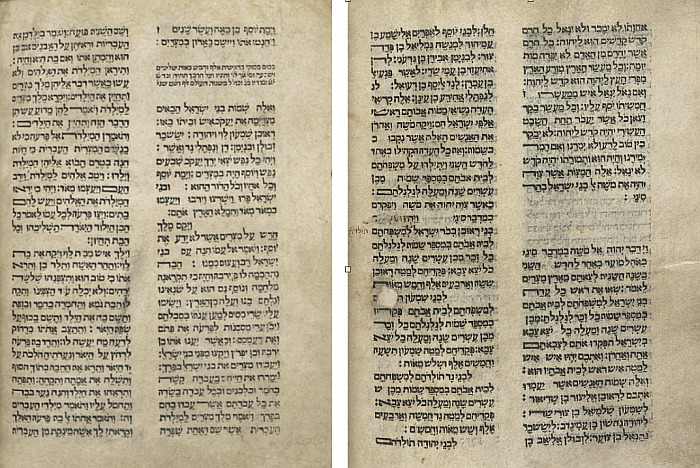
The Faro Pentateuch, 1487
First page of the Book of Exodus on the left
First page of the Book of Numbers on the right
The British Library, London, United Kingdom
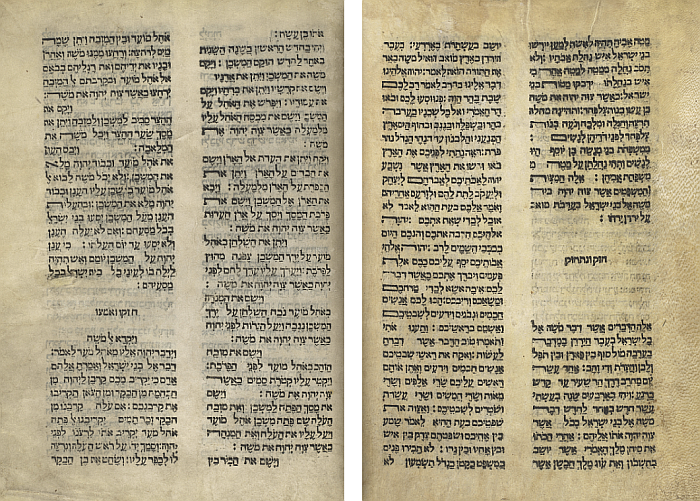
The Faro Pentateuch, 1487
First page of the Book of Leviticus on the left
First page of the Book of Deuteronomy on the right
The British Library, London, United Kingdom
1 Professor Emeritus, College of William & Mary, VA, USA, Rabbi, Chabad of Virginia, VA, USA. He is the co-author with R. Eli Rosenfeld of the recently published Monuments of Paper and Parchment: Hebrew Printing in Portugal in the late 15th century. Chabad Portugal Press, 2025.
2 Adri Offenberg, Hebrew Incunabula in Public Collections: A First International Census (Nieuwkoop: De Graaf Publishers, 1990); Adri Offenberg, Catalogue of Books printed in the 15th Century now in the British Museum. Part XIII: Hebraica. (Hec & de Graaf, Goy, 2004); Chaim Dov Friedberg, History of Hebrew Typography in Italy, Spain-Portugal, and Turkey (Tel Aviv: Bar-Juda, 1956); and Tiago Moita, O Livro Hebraico Português na Idade Média (Lisboa: Faculdade de Letras da Universidade de Lisboa, 2017).
3 Joshua Bloch, "Early Hebrew Printing in Spain and Portugal," Bulletin of the New York Public Library 42 (1938); Marvin J. Heller, Studies in the Making of the Early Hebrew Book (Leiden: Brill, 2008).
4 The campaign has been led by the Associação Faro 1540 (Associação de Defesa e Promoção do Património Ambiente Cultural de Faro). On the repatriation request, see Peter Booker, Annual Report of the British Historical Society of Portugal 46 (2019), pp. 23–36.
5 This conflation is widely accepted as an unquestioned fact in the local, popular, and even official and semi-official discourse. It also often appears explicitly in local press coverage, cf. "First Book Printed in Portugal 530 Years Ago (Re) Launched Today in Faro," Sul Informação, June 29, 2017, which refers to this copy of this incunabulum as one "which was removed during the incursion of the Earl of Essex."
6 For details and sources about the history of Hebrew printing in Portugal see, for example, Artur Anselmo, Origens da imprensa em Portugal (Lisboa: Imprensa Nacional, Casa da Moeda, 1981); and João Oliveira, “A Produção de incunábulos hebraicos em Portugal nos finais do século XV,” In O livro e as interações culturais judaico-cristãs em Portugal no final da Idade Media edited by Luis Urbano Afonso and Paulo Mendes Pinto (orgs.) (Lisboa: Cátedra de Estudos Sefarditas Alberto Benveniste: pp.119-144, 2014).
7 In recent years it has been suggested that Faro might also be the place of origin of an early printed edition of the Targum Onkelos, of which only two leaves have survived and are now in the archives of the National Library of Israel. This, if clearly proved, may be a highly consequential development if the notion that it predates the Faro Pentateuch were to prevail.
8 See, for example, the listings under the Incunabula Short-Title Catalogue at https://data.cerl.org/istc/.
9 On the Faro edition of the Talmud see Shlomo Pereira, “The Faro Talmud: Colophon Ambiguities and the Transmission of Sephardic Traditions in the Early Diaspora,” Sephardic Horizons, Vol.16, Issue1-2.
10 See, for example, Francois Soyer, Perseguição dos judeus e muçulmanos em Portugal. (Lisbon: Edições 70, Ltd, 2013) and Francois Soyer, “King Manuel I and the expulsion of the Castilian Conversos and Muslims from Portugal in 1497: New Perspectives.” Cadernos de Estudos Sefarditas 8. pp. 33-62 (2008).
11 Interestingly, the last know books printed in a Hebrew printing house in Portugal were two versions in the vernacular, in Spanish and in Latin, of the Almanach Perpetuum, the masterwork of R. Abraham Zacuto, which would play a significant role in the Iberian maritime exploits. This is also the first known case of a vernacular-language book having been printed in a Hebrew printing house.
12 As it would be the case with the Pentateuch printed in Lisbon in 1491, of which copies are extant printed both on paper and on parchment.
13 Irina Wandrey, “How to Avoid Some Pitfalls while Interpreting Dates in Hebrew Manuscripts,” in Jewish Manuscript Cultures: New Perspectives, ed. Elvira Martín-Contreras, and Lola Ferre (Berlin: De Gruyter, 2020), 205–241, and Marvin J. Heller, (2008).
14 This discussion on the provenance of the copy in the British Library uses as starting point the information presented in https://data.cerl.org/mei/02124967. The ownership inscriptions are also discussed although briefly in Shlomo Pereira and Eli Rosenfeld, Monuments of Paper and Parchment: Hebrew Printing in Portugal at the End of the 15th Century (Lisbon: Chabad Portugal Press, 2025).
15 Robert Bonfil, Jewish Life in Renaissance Italy (Berkeley: University of California Press, 1994); David B. Ruderman, Early Modern Jewry: A New Cultural History (Princeton: Princeton University Press, 2010).
16 Jewish Encyclopedia (1906) – Sforno entry.
17 "Almanzi, Joseph," in Encyclopaedia Judaica, 2nd ed. (Detroit: Macmillan Reference USA, 2007), 1:679–680; “Almanzi, Joseph," in Jewish Encyclopedia (New York: Funk and Wagnalls, 1901–1906), 1:429.
18 Samuel David Luzzatto and Giuseppe Almanzi, Catalogue de la Bibliothèque de littérature hébraïque et orientale de feu Joseph Almanzi (usually referred to as Yad Yosef) (Padua: s.n., 1864).
19 The Faro Pentateuch is identified as part of the Almanzi collection as early as 1852 by documents from the Bodleian Library of Oxford University. See M. Steinschneider, Catalugus librorum hebraeorum in bibliotheca Bodleiana: jussu curatorum] digessit et notis instruxit M. Steinschneider (Berlin: Ad. Friedlander, 1852-1860).
20 Solomon Schechter, "The Hebrew Collection of the British Museum," in Studies in Judaism: First Series (Philadelphia: Jewish Publication Society, 1896), 282–306; "British Museum," in Jewish Encyclopedia (New York: Funk and Wagnalls, 1901–1906), 3:390–395.
21 "Almanzi, Joseph," Jewish Encyclopedia, 1:429; and “Asher Rare Books (Since 1830).” ILAB – International League of Antiquarian Booksellers (company history page), https://ilab.org/affiliate/asher-rare-books-since-1830.
22 Ilana Tahan "The Hebrew Collection of the British Library: Past And Present,” European Judaism: A Journal for the New Europe, Autumn 2008, Vol. 41, No. 2 (Autumn 2008), pp. 43-55; see also the entry in George Margoliouth, Catalogue of the Hebrew, and Samaritan Manuscripts in the British Museum, 4 vols. (London: British Museum, 1899–1935).
23 "Almanzi, Joseph," Jewish Encyclopedia, 1:429; Michelle Chesner Margolis, “History of Jewish Studies Collections at Columbia,” Columbia University Libraries. It should be mentioned that the available documents offer two different dates of acquisition by Temple Emanuel: 1862 and 1872. The earlier date cannot be correct as the whole collection was still in the possession of the family in 1864 when the catalog of the collection was published.
24 Booker, "The Earl of Essex and the Bishop's Library," 23–30; João Teles e Cunha, A Memória à Luz da História, ou a Biblioteca do Bispo do Algarve Revisitada (Faro: Universidade do Algarve, 2007).
25 Ibid., 29–30.
26 "Fernando Martins Mascarenhas," in David M. Cheney, Catholic-Hierarchy.org; Booker, "Earl of Essex," 30.
27 Booker, "Earl of Essex," 32.
28 The Bodleian Quarterly Record 3, no. 34 (1922): 241–244.
29 Multiple scholars have noted this absence; see Booker, "Earl of Essex," and cf. the inventory published in the Bodleian Quarterly Record.
30 See footnote 20.
31 Abraham Sabba's account is preserved in his Tzror HaMor; see Encyclopaedia Judaica, 2nd ed. (Detroit: Macmillan Reference USA, 2007), s.v. "Saba, Abraham ben Jacob."
32 Elijah Capsali, Seder Eliyahu Zuta, ed. Aryeh Shmuelevitz, Shlomo Simonsohn, and Meir Benayahu (Jerusalem, 1975–83), vol. 1; see also François Soyer, The Persecution of the Jews and Muslims of Portugal: King Manuel I and the End of Religious Tolerance (1496–7) (Leiden: Brill, 2007), pp. 216–230.
33 On the fate of confiscated Hebrew books in Portugal, see Soyer, Persecution, pp. 225–230; and Marvin J. Heller, *Studies in the Making of the Early Hebrew Book (Leiden: Brill, 2008), pp. 37–39.
34 On the use of Hebrew book possession as evidence in Portuguese Inquisition trials, see António Baião, A Inquisição em Portugal e no Brasil (Lisbon: Arquivo Histórico Português, 1906); and the manuscript Memória de todos os autos da fé que se tem feito em Lisboa (ca. 18th century), identified in the Central Archives for the History of the Jewish People, National Library of Israel.
35 On Christian Hebraists and Hebrew book ownership, see Stephen G. Burnett, Christian Hebraism in the Reformation Era (1500–1660): Authors, Books, and the Transmission of Jewish Learning (Leiden: Brill, 2012).
36 Booker, "Earl of Essex," p. 32; The Bodleian Quarterly Record 3, no. 34 (1922): 241–244.
37 The Faro Talmud fragments, discovered in a bookbinding in Leiden in 1908, exemplify this phenomenon. See Shlomo Pereira, "Echoes of Sepharad: Hidden in a Bookbinding—The Faro Talmud and the Afterlife of a Lost Portuguese Printing," Times of Israel Blogs, February 1, 2026.
38 Pereira and Rosenfeld (2025).