
Scions of a Distinguished Family of Eminent, Prolific, and Scholarly Authors
Part 2 - Hayyim ben Israel Benveniste
By Marvin J. Heller1
The Benveniste family, notable, prestigious, and prominent, provided Jewish society with leaders and sages for almost a millennium. In our previous article about the brothers, Joshua Raphael and Hayyim ben Israel Benveniste, we focused on Joshua Raphael Benveniste. In this article we now turn to our second Benveniste, the younger brother, Hayyim ben Israel Benveniste.
Hayyim ben Israel Benveniste (1603-73) was born and raised in Constantinople in the home of his grandfather, R. Moses Benveniste (d. after 1695), a person of eminence, physician, and medical attender to the grand vizier, Siavouch Pasha.2 Hayyim was a student of R. Joseph ben Moses Trani (Maharit, 1568 – 1639) in Constantinople, as was his brother Joshua Raphael. Hayyim was particularly close to Trani, who arranged his marriage to the daughter of a wealthy man.3 Hayyim was also a student of R. Joseph ben Benjamin Samego (Samigah, d. 1629), who was born in Salonika, served as rabbi and head of a yeshivah in Venice and in Padua. Among Samego’s works are Miḳra’e Ḳodesh (Venice, 1586), on the 613 commandments, Porat Yosef (ib. 1590), novellæ on the Sefer ha-Halakot and novelæ on a part of the Tosafot to tractates Ketubot, Beẓah, and Zevaḥim; and Perush Derek Yamin (ib. n.d.), comprised of homilies, cabalistic notes, and an explanation of the Ten Sefirot.4
Hayyim Benveniste is highly regarded. Hayyim (Heimann) Michael describes him as ha-rav החבי"ב (dear, cherished) based on an acronym of his name Hayyim ben Israel Benveniste חיים בן ישראל בנבנשת.5 At the relatively young age of twenty-two he was appointed a supervisor of kashrut requirements (Issur ve-Hetter), a position generally assigned to more senior and experienced authorities. In 1643, Hayyim became rabbi of Tire (Tirya), a neighboring community of Izmir (Smyrna). He served there for close to fifteen years, until, in 1658, he became rabbi in Izmir, succeeding the elderly R. Joseph ben Saul Escapa (1570--1662), and serving there jointly with R. Aaron Lapapa.6
Parenthetically, Izmir in western Anatolia, was a flourishing commercial center, home to a small Jewish community for well over a millennium. The city and its Jewish community began to flourish at the beginning of the seventeenth century when Jews from adjoining cites settled there. R. Joseph Escapa, who had served as rabbi and head of the yeshivah in Salonica, was subsequently appointed rabbi in Izmir. Among his students was the soon-to-be pseudo-messiah Shabbetai Zevi (1626–1676), whom he ordained but subsequently excommunicated and declared it a religious obligation to put him to death. Escapa was the author of Rosh Yosef, on Oraḥ Ḥayyim (Izmir, 1657), and Ḥoshen Mishpat (ibid., 1659) of which portions only were published. He also wrote Teshuvot Rosh Yosef, responsa (Frankfurt on the Oder, 1709), and a work on Maimonides still in manuscript.
R. Aaron ben Isaac Lapapa (c. 1604-1667) was also a student of R. Joseph de Trani. He served as rabbi in Magnesia, a poor community, without pay, as well as head of a yeshivah. He was appointed rabbi of Izmir in 1665 together with Ḥayyim Benveniste, with the latter’s concurrence. Lapapa oversaw halakhic issues of civil law, while Benveniste addressed matrimonial, festival, and ritual issues. Lapapa was an unremitting opponent of Shabbetai Zevi, also advocating the death penalty for him. He was relieved of his post in Izmir by Shabbetai Zevi. After Shabbetai’s apostasy, attempts were made to reinstate Lapapa but it is unclear whether they were successful, as they were opposed by Shabbetai’s adherents. Among Lapapa’s works are Benei Aharon (Izmir, 1674), responsa on Ḥoshen Mishpat, as well as novellae and responsa on Orah Ḥayyim and Yoreh De’ah, published in R. Baruch Kalomiti’s Avak Derakhim (Salonika, 1814), as well as other works still in manuscript.
In contrast to both Escapa and Lapapa, Hayyim Benveniste became an adherent, albeit briefly, and of questionable commitment, of Shabbetai Zevi. The latter, known to be “inconstant in his human relations,” at one point threatened to excommunicate Benveniste and feed him the flesh of camels. Later, when asked,
“why he so violently abused and publicly insulted an eminent and blameless rabbi, he replied – to everyone’s surprise – that he had meant to praise and not, God forbid, to revile Benveniste, The remark about feeding him the flesh of camels had a profound kabbalistic significance, since the Hebrew word for ‘camel’ (gml) was the same as that for ‘dealing (gml) kindly,’ and he ‘bestoweth (gml) lovingkindness. . .’ This was a complete about-face, and Sabbatai now began to sing the praise of Benveniste.”
Subsequently, Benveniste repudiated the pseudo-messiah’s movement after Shabbetai Zevi’s apostasy, when he converted to Islam.7
Benveniste was a prolific writer. Yeshayahu Vinograd, in his Thesaurus of the Hebrew Book, attributes seventeen titles to Hayyim Benveniste, although several of those volumes are portions of Hayyim’s larger and most significant work, Kenesset Gedolah, an eight-part commentary on the Shulhan Aruch.8 Benveniste, when only twenty-one, had previously begun writing Dina de-Hayyei (Constantinople, 1742), his commentary on R. Moses of Coucy’s Sefer Mitzvot Gadol (Semag), , however it was not published until 1742. Benveniste’s other works, described below, include Ba’ei Hayyei, responsa printed over several years in the 18th century; Hemer Hivver Attik (Livorno, 1802), novellae on Sanhedrin; and Pesah Me’uvin, on the Haggadah (Venice, 1692, below).
Keneset ha-Gedolah – Keneset ha-Gedolah is a comprehensive concise compilation of all halakhic decisions from the time of R. Joseph Caro’s (1488-1575) Shulhan Arukh) to Benveniste’s time. The first part of Keneset ha-Gedolah was printed in Livorno in תשיח (1657-58) in folio format (20:6, 164 ff.) at the press of Jedidiah ben Isaac Gabbai.9
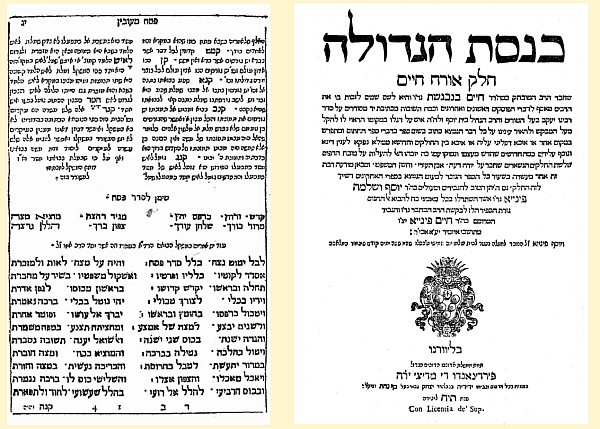
Orah Hayyim Keneset ha-Gedolah
1657-58, Livorno
Courtesy of Virtual Judaica
This, the first volume published of Keneset ha-Gedolah is on Orah Hayyim only. The title page informs that it brings the words of decisors, early and later, and many responsa from manuscripts, all in the order of the Turim, containing diverse and contrary opinions, and many of Benveniste’s own novellae. It notes that the other parts remain to be printed. Publication was made possible by R. Joseph and Solomon Piniea.
The title page is dated 418 (= 1657/58) but the colophon gives a more explicit date for completion of the work, 17 Kislev, “Let my soul live תחי (618 = Friday, November 23, 1657), and it shall praise you” (Psalms 119:175). There is an approbation signed by six rabbis; a lengthy introduction from Benveniste’s son, R. Israel Benveniste (fourteen at the time); a second introduction from Benveniste’s brother, R. Joshua Benveniste; and brief prefaces from the editor, R. Abraham ben Samuel Gedili,; and the publisher, Jedidiah Gabbai. The text follows, in two columns in rabbinic type. At the end of the volume are pilpulim on Rashi, Tosafot, and other decisors (94a-164b) including a section on the language of the Rashba, Ritba, Rambam, Ramban and others, concluding with the principles and methodology of the Talmud and the poskim.
Keneset ha-Gedolah was the first work after the Shulhan Arukh to assemble all of the subsequent responsa, as well as including earlier poskim omitted by Caro. It is more than a compilation, however, being also a commentary on the former work, the Tur and Beit Yosef, with added novellae. Although Benveniste’s intent is to compile rather than determine the halakhah, he frequently indicates the decisor he believes to be correct. Hida (R. Hayyim Joseph David Azulai) writes (Shem ha-Gedolim, 1: het 17) that no decisions should be rendered without first consulting Keneset ha-Gedolah. Addenda to Orah Hayyim entitled Sheyarei Keneset ha-Gedolah were published in Izmir (1671) as was the first part of Hoshen Mishpat (1660). The remaining volumes were published later, so that the entire work comprises eight volumes.10
Pesah Me’uvin – Our next Hayyim Benveniste publication is Pesah Me’uvin, a commentary on the Pesah Haggadah. It was published in Venice by the renowned Bragadin press (founded in 1550 by Alvise Bragadin) in the year, “to guard the way of the tree of life דרך עץ חיים (452 = 1692)” (Genesis 3:24) in quarto format (40: 30 ff.).
The ornate Bragadin title page instructs readers in all the laws of issur ve-heter by the pure lamp. Pesah Me’uvin pertains to the evening of the fourteenth of Nissan, the search for hamez, and the order of prayers for the first night of the festival of Pesah. Its subject matter encompasses kiddush, havdalah, and tikkun, making and eating mazah, and the order of the Haggadah and all of its statutes and ordinances.
The introduction (2a-b) follows, informing that Pesah Me’uvin is derived from the first and second editions of Keneset ha-Gedolah; it was entitled Pesah Me’uvin because it is mixed, compounded, and thick with numerous explanations, as Rashi states (Pesahim 64b), “because the people were numerous.” The Talmud there states,
you will not find, from all the pesah offerings, any that did not have more than ten people registered for it, so that they called it the thick pesah (pesah me’uvin),
a reference to the multitudes participating. Benveniste’s commentary begins in two columns in rabbinic type followed by evening prayers in square vocalized letters. The remainder of the volume is comprised of the Haggadah and commentary, in the same formats, all within a single thin-line frame. Pesah Me’uvin is halakhic in content. Leaf 13a has verse based on the Pesah symbols by R. Joshua Benveniste, the author’s brother.
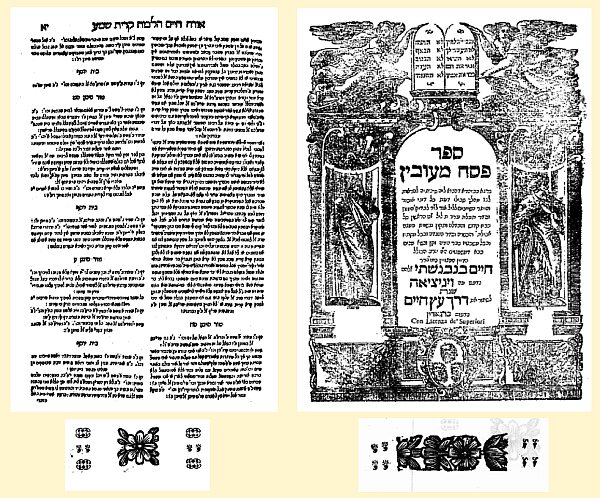
1692, Pesah Me’uvin
Courtesy of Virtual Judaica
The Haggadah was printed in two editions, one according to the Ashkenazic rite, the other according to the Sephardic rite. The latter (28 ff.) lacks the final leaf with the piyyutim Ehad mi Yodea and Had Gadya sung by the Ashkenazim. There are no illustrations, the only decorative material are floral woodcuts accompanying the introduction and appearing in one instance elsewhere. Pesah Me’uvin has been reprinted several times and included with other commentaries in haggadot.11
Dina de-Hayyei – Hayyim Benveniste’s commentary on R. Moses of Coucy’s (early 13th century) Sefer Mitzvot Gadol (Semag). Dina de-Hayyei was published in folio format (20: [2], 211, 136 ff.) at the press of Reuben and Nissin Ashkenazi in the year “In the light of the king’s countenance is life באור פני מלך חיים לפ "ג (507=1740)” (Proverbs 16:15).12
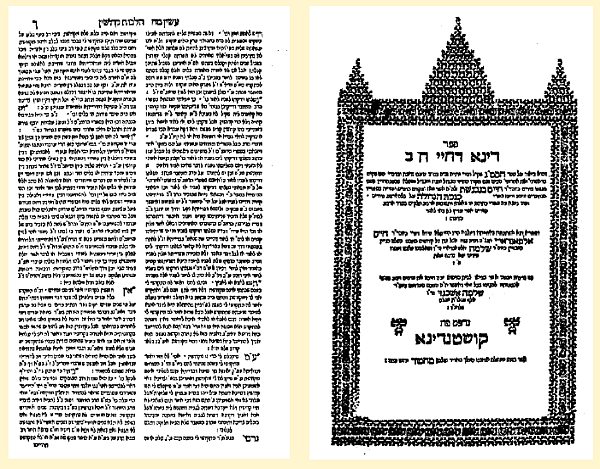
1742, Dina de-Hayyei
Courtesy of the National Library of Israel
The press of Reuben and Nissin Ashkenazi in Constantinople was founded in 1710 by their father, Jonah ben Jacob Ashkenazi. Avraham Yaari notes that the surname Ashkenazi was added by Jonah Ashkenazi who came from the area of Levov (now Lviv) in Eastern Galicia to Constantinople, to indicate his origin. He credits him with making Constantinople into the metropolis of Hebrew printing in the Middle East. The Ashkenazi print shop, operated by three generations of the Ashkenazi family, continued to print Hebrew works until 1778, issuing almost two hundred works. At one time it employed as many as fifty workers. Yaari records eighty-three workers including Ashkenazim (29), Sephardim (37), and converts to Judaism (4), as well as others not clearly identified, at the press. Among them were three generations from the same family.13 When the Turks, who had refrained from printing in their own language for almost two and a half centuries after the first Hebrew book had been printed in Constantinople, permitted Ibrahim Müteferrika to establish the first Turkish press in 1727, Jonah Ashkenazi designed and cast the Arabic letters as well as instructed Müteferrika in the operation of the print shop.14
As was customary, the Ottoman Sultan is acknowledged on the title page, in this case Mahmud I (reigned 1730-54). Dina de-Hayyei is Benveniste’s commentary on Sefer Mitzvot Gadol (Semag), a halakhic work built on an enumeration of the taryag (613) mitzvot, as noted above.15 The author, R. Moses ben Jacob of Coucy, was a Tosafist preacher who, beginning in 1235/36 traveled through Spain and Provence, admonishing Jews on their lax observance of mitzvot, such as tefillin, mezuzah, and zizit, and their relationships with non-Jewish women, and calling for greater Torah study. An eloquent speaker, Moses of Coucy influenced many thousands to adopt a more observant lifestyle. He was also one of the disputants with Nicholas Donin in Paris in 1240 in defense of the Talmud.
Dina de-Hayyei, a detailed work, was published in two parts. The text is preceded by an approbation from R. Abraham ben Joseph Rosenes, R. Shabbetai ha-Levi, R. Isaac ben David, and R. Isaac Rosenes, Constantinople rabbis, the editor, Solomon Ashkenazi, the introduction, and then the text in two columns in rabbinic letters. It is concluded with a lengthy list of the sources used by Hayyim Benveniste in preparing Dina de-Hayyei.
The Semag was first printed in Rome prior to 1480. A popular work, Ch. B. Friedberg records seven editions of Sefer Mitzvot Gadol through 1905, although there have been more recent reprints, possibly facsimiles. This is the only edition of Dina de-Hayyei.16
Ba’ei Hayyei – Responsa by Hayyim Benveniste was published in Salonica at the press of Mordecai Nachman and David Israelije, a press active for over 50 years. Ba’ei Hayyei is based on manuscripts found primarily in the archives of R. Hezkia Raphael Hayyim Alfondari and his brother Abraham Alfondari, and to a lesser extent by R. Samuel Gaon and R. Aaron Lippe.17
Ba’ei Hayyei was published in three parts from 1788-91, that is from the year “because of your majestic sanctity from the inception [of your reign] בהדרי קדש מרחם משחר ([5]548 = 1788)” (Psalms 110:3) through “All who are inscribed for life כל הכתוב לחיים ([5]551 = 1791)” (Isaiah 4:3).
Ba’ei Hayyei is responsa on all four parts of the Arba’ah Turim; Orah Ḥayyim is addressed in the 1788 edition, Yoreh De’ah and Even ha-Ezer in the 1788 edition, and Ḥoshen Mishpat in the 1791 edition. Several of these imprints are in two parts. Each section has an individual title, Orah Ḥayyim as Etz ha-Hayyim, Yoreh De’ah as Etz ha-Da’at, Even ha-Ezer as Etz ha-Gan, and Ḥoshen Mishpat as Etz Hadar. All are noted on the verso of the title-page of the final volume of Ba’ei Hayyei.
1788, Ba’ei Hayyei 1791, Ba’ei Hayyei
Courtesy of the National Library of Israel
The title pages have a double border of florets with verses between them, from the top and sides of the page are “They are life to him who finds them, Healing for his whole body” (Proverbs 4:22); followed by “For they will bestow on you length of days, years of life and well-being” (Proverbs 3:2); followed by “For he who finds me finds life and obtains favor from the Lord” (Proverbs 8:35); and “For through me your days will increase, and years be added to your life” (Proverbs 9:11). Here, too, the Ottoman sultans are acknowledged on the title pages, Abdul Hamid I (reigned 1774-89) and Selim III (reigned 1789-1809).
The title page is followed by a brief introductory paragraph by Benveniste beginning:
this is the portion of a man, who must slay himself in the tent of the Torah, to reply to the sayings, pure sayings, of the Lord . . . to respond to those who enquire as to the law, concerning matters between individuals, financial, prohibitions, or blessings. They will inquire as to what is the judgment, moreover what is his judgment?
He continues that he has entitled this work “Ba’ei Hayyei (eyes [judgements] of my life) questions that I have been asked, I the young man, Hayyim.” This is followed by a lengthy introduction by the dayyan (rabbinic judge), R. Hayyim Baruch Sapportah, and then the text in two columns in rabbinic letters.
The responsa are detailed and frequently extensive. At the end of the volume is an index of the responsa. In addition to the responsa in Ba’ei Hayyei, several of Benveniste’s responsa are included in the works of his students, contemporaries, and other halakhic authorities.
Hamra ve-Hayyei –
Our final Ḥayyim Benveniste work, Hamra ve-Hayyei, are novellae on tractate Sanhedrin. Ḥamra ve-Ḥayyei was published in folio format (20: [1], 145 ff.) in Livorno (Leghorn) in the year “The righteous man will rejoice ישמח צדיק ([5]562 = 1802)” (Psalms, var. cit.) at the press of Eliezer Sadon.
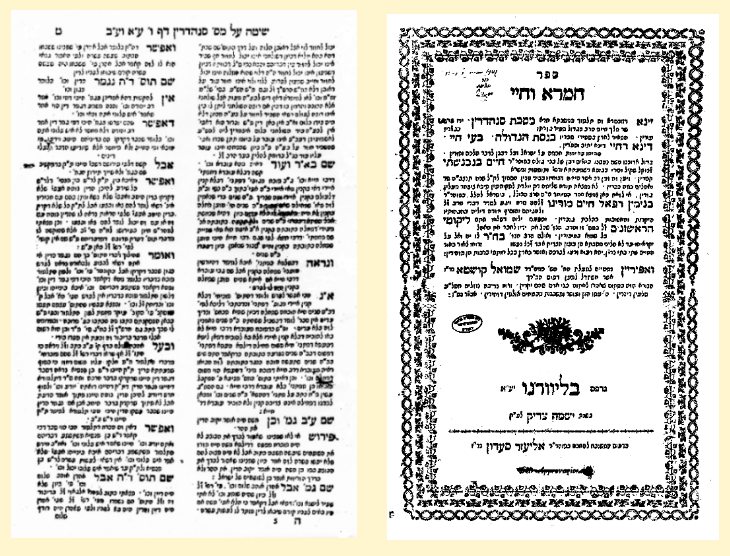
1802, Hamra ve-Hayyei
Courtesy of the National Library of Israel
Although Benveniste wrote novellae on several tractates, only those on Sanhedrin, and part only of that extant, were published from a manuscript. The novellae, in two columns in rabbinic letters, concludes on 52b of Sanhedrin (the tractate consists of 113 folio), and a tail-piece with two cherubim.

In addition to the above titles, other Benveniste works remain in manuscript. R. Hayyim Benveniste passed away on 19 Elul 5433 (Thursday, August 31, 1673). He was succeeded as the rabbi of Izmir by his son, Israel (1644-1729). Among his students were several rabbis of distinction, among them R. Solomon ibn Ezra, R. Isaac Algazi, R. Ḥayyim Algazi, and R. Abraham ben Aaron de Boton.18 Hayyim Benveniste was a remarkable and distinguished member of an outstanding and distinguished family. His works, comprehensive, authoritative, and influential, are highly regarded, valued and referenced to this day.
1 Once again, the author would like to express his gratitude and appreciation to Eli Genauer for reading this article and his helpful corrective annotations. Marvin J. Heller is an award winning author of books and articles on early Hebrew printing and bibliography. Among his books are the Printing the Talmud series, The Sixteenth and Seventeenth Century Hebrew Book(s): An Abridged Thesaurus, and several collections of articles.
2 Israel Benveniste, Joshua Raphael and Hayyim Benveniste’s father, passed away in 1627, when his sons were relatively young. Shimon Vanunu, Encyclopedia le-ḥakhme Ṭurḳyah: toldot ḥayehem ṿi-yetsirotehem shel rabane Ṭurḳyah (Jerusalem 2006), p. 415 [Hebrew].
3 Concerning R. Joseph Trani, see part one of the Benveniste brothers’ article in Sephardic Horizons,Vol.16, Issue 1-2.
4 Isidore Singer, M. Seligsohn, “Samegah, (Samigah), Joseph ben Benjamin” Jewish Encyclopedia vol. 10 (New York, 1901-06), pp. 683-84.
5 Hayyim (Heimann) Michael, Or ha-Hayyim: The Sages if Israel and their Literary Works (Frankfurt am Main, 1891, reprint, Jerusalem, 1965), pp. 385-88 no. 862 [Hebrew].
6 The background information on Hayyim Benveniste is a compilation of biographic information from Richard Gottheil, Meyer Kayserling, Isaac Broydé, “Benveniste” (Jewish Encyclopedia. vol. 3, pp. 38-41; Hersch Goldwurm, The Early Acharonim: Biographical Sketches of the Prominent Early Rabbinic Sages and Leaders from the Fifteenth-Seventeenth Centuries (Brooklyn, 1989), pp. 182; Mordechai, Margalioth, ed., Encyclopedia of Great Men in Israel II (Tel Aviv, 1986), cols. 494-95 [Hebrew]; Moshe Nahum Zobel, “Benveniste (or Benvenist), Ḥayyim ben Israel,” Encyclopedia Judaica, Jerusalem, 2007), Volume 3, pp. 82-83; and Encyclopedia Judaica, op. cit.; Shimon Vanunu, Encyclopedia Arzei ha-Levanon. Encyclopedia le-Geonei ve-Ḥakhmei Yahadut Sefarad ve-ha-Mizraḥ II (Jerusalem, 2006), pp. 603-608.
7 See Gershom S. Scholem, Sabbatai Sevi; the Mystical Messiah (Princeton, 1973), pp. 402, 405, and for a more detailed discussion of Benveniste and Shabbetai Zevi, var. cit.
8 Yeshayahu Vinograd, Thesaurus of the Hebrew Book. Listing of Books Printed in Hebrew Letters Since the Beginning of Printing circa 1469 through 1863 I (Jerusalem, 1993-95), p. 206 [Hebrew].
9 Concerning Hebrew printing in Livorno see Ch. B. Friedberg, History of Hebrew Typography in Italy, Spain‑Portugal and Turkey, from its beginning and formation about the year 1470 (Tel Aviv, 1956), pp. 86-87 [Hebrew]; Marvin J. Heller, “Jedidiah ben Isaac Gabbai and the First Decade of Hebrew Printing in Livorno” Los Muestros, part I no. 33 (Brussels, 1998), pp. 40-41; part II no. 34 (1999), pp. 28-30, reprinted in Studies in the Making of the Early Hebrew Book (Leiden/Boston, 2008), pp. 165-77; idem., “Abraham ben Raphael Meldola and the Resumption of Printing in Livorno” International Sephardic Journal 2:1 (Orlando, Fl., 2005), pp. 83-94, reprinted in Studies, pp. 178-90.
10 Michael, op. cit.; Chaim Tchernowitz, Toledoth ha-Poskim, III (New York, 1946), pp. 313-18 [Hebrew].
11 Isaac Yudlov, The Haggadah Thesaurus. Bibliography of Passover Haggadot From the Beginning of Printing until 1960 (Jerusalem, 1997), p. 11 nos. 88-89 [Hebrew].
12 Hebrew dates are frequently comprised of chronograms in which the dates are determined from the numerical value of the letters from a verse, often emphasizing selected enlarged letters. The date of books employing chronograms, a common practice at this time, can be derived by adding 1240, the year the fifth millennium in the Hebrew calendar began, to the numerical value of the selected letters. For example, in this case the numerical value of the verse באור פני מלך חיים is, as given above (507=1740). Verses are either לפ "ג or לפ "ק, the former לפ" ג for the full or the latter לפ" ק for abbreviated era, in which case, the millennium, that is, the 5 is not part of the numeration and is given in brackets. On the use of chronograms to date books see Marvin J. Heller, “Chronograms on Title Pages in Selected Eighteenth Century Editions of the Talmud,” Studies in Bibliography and Booklore (SBB) XVIII (Cincinnati, 1993), pp. 3-14, reprinted in Studies in the Making of the Early Hebrew Book. Brill, Leiden/Boston, 2008, pp. 54-71.
13 Avraham Yaari, Hebrew Printing at Constantinople (Jerusalem, 1967), pp. 38, 49 [Hebrew].
14 Stanford Shaw, The Jews of the Ottoman Empire and the Turkish Republic (New York, 1991), p. 146.
15 C. Tchernowitz, Toledot ha-Posekim II (New York, 1946), pp. 87-95 [Hebrew]; Yaari, Constantinople, p. 196, no. 389.
16 Ch. B Friedberg, Bet Eked Sepharim, (Israel, n.d.), mem 3294; daled 803 [Hebrew].
17 Samuel Glick, Kunteres ha-Teshuvot h-Hadash; A Bibliographic Thesaurus of Responsa Literature vol. 1 (Jerusalem and Ramat-Gan, 2006), p. 151 n0. 596 [Hebrew].
18 Margalioth, op. cit.; Encyclopedia Judaica, op. cit.
Copyright by Sephardic Horizons, all rights reserved. ISSN Number 2158-1800