
Dahlia Abraham-Klein
THE STATELESS CENTRAL ASIAN MERCHANT
The Life of Haim Aghajan Abraham
Based on His Journal (1897–1986)
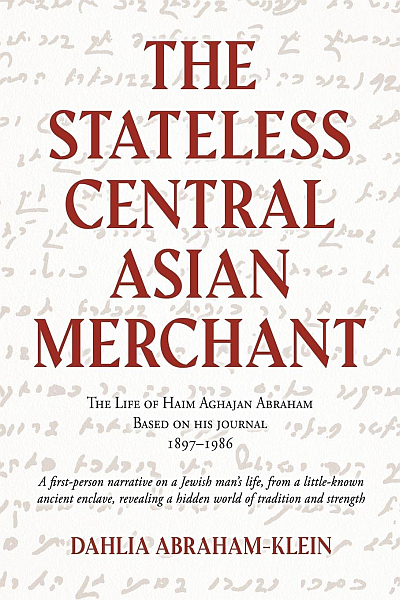
Great Neck, NY: Shamashi Press, 2025, ISBN: 9798218677282
Reviewed by Drora Arussy1
The Stateless Central Asian Merchant: The Life of Haim Aghajan Abraham, Based on His Journal (1897–1986) by Dahlia Abraham-Klein is a deeply engaging and intimate portrait of a lost Jewish world told through the life of one merchant whose journeys spanned Central Asia, Afghanistan, India, and Iran, followed by moving to Japan for twenty-five years, and finally settling in Forest Hills, Queens. Built on Haim’s own Judeo‑Persian journal and enriched by family memory, the book extends the personal, intergenerational storytelling that Abraham began in Caravan of Hope into an even wider geographic and historical canvas using her grandfather’s journals.
At its heart lies a simple but extraordinary fact; in his nineties, Haim Aghajan Abraham sat down with a spiral notebook and, in Judeo‑Persian written in what is today referred to as Rashi script, recorded the story of his life. He wrote without convention, leaving no margins and in no particular order. This journal is now preserved in the Central Asian archives at the Hebrew University together with Haim’s passport. Abraham-Klein’s work carefully translates, shapes, and frames his words, inviting readers into a vanished world where borders were porous, empires unstable, yet family, faith, and commerce provided continuity.
In the introduction, Abraham-Klein provides a historical overview of Central Asian and Afghan Jewish life, outlining major political changes, trade networks, and migration patterns that form the backdrop to Haim’s travels. A family tree is included alongside this overview, identifying key relatives across several generations and clarifying how different branches of the Abraham family are connected. These elements supply chronological and genealogical context for the episodes drawn from Haim’s journal.
The narrative opens in chapter one with “This is the history of my life from the day I was born in the city of Merv…” The book traces Haim’s life from Marv (Merv), with its three synagogues and mix of Afghan, Bukharan, and Ashkenazi Jews, through the upheaval of expulsion under Russian rule, to the commercial hubs of Samarkand, Kabul, Bombay, and beyond. Abraham-Klein is at her best when she stays close to his experiences: the sarai caravan compounds, the karakul and silk trades, the family courtyards that functioned as both home and economic unit, and the synagogues and communal institutions financed by successful merchants. These details, drawn from the journals and family stories, give the book a vivid sense of place and history.
Readers of Caravan of Hope will recognize Abraham-Klein’s characteristic intergenerational framing. In the earlier book, she followed her mother’s journey as a Bukharan woman seeking education, autonomy, and a new life; here she turns to her grandfather’s world and shows how his choices and character shaped the paths available to later generations. The theme of responsibility passes like a thread through the book: Haim as the eldest of nine, bearing family burdens early; Abraham’s mother as the eldest in her generation; Abraham-Klein herself, though the youngest of her siblings, choosing to “step up” and become the family’s chronicler. The result is a layered story in which the past presses on the present.
Some of the most striking moments come when Haim’s ethical instincts surface in the midst of upheaval. In one episode, he travels to Bukhara amid rumors of violence, only to find himself invited to help himself to the abandoned treasures of the Amir’s palace after a revolutionary upheaval. Surrounded by carpets and silks, he refuses, wondering from whose blood these goods were taken. The scene is brief, but Abraham draws it out just enough to reveal a man whose moral compass remains steady even when no one is watching. In another episode, his severe lung illness leads him to a remote village to drink mare’s milk day and night, a choice that opens quiet questions about kashrut and health in remote areas.
While Abraham does introduce historical background including Russian policies in Turkestan, the expulsion from Marv, the role of Central Asian merchants in building Jerusalem’s Bukharan Quarter, this context is always in service of the story. She offers just enough information to help readers understand the stakes of a given episode or the meaning of a place name, then returns quickly to Haim’s voice and the family’s lived experience. The book is therefore driven more by narrative and character than by argument or theory and its primary ambition is to bring a hidden world to life rather than to intervene in scholarly debates, even though it will certainly interest researchers as a rare, source‑based account. Included are some family photos that help to round out the picture of Haim’s life as well as a rich list of suggested further reading.
The connection to Caravan of Hope is more than biographical. In that earlier work, Abraham-Klein showed how one woman’s life could illuminate broader questions about migration, gender, and identity in the Bukharan and Afghan Jewish diaspora. Here she does something complementary; she uses her grandfather’s journals to explore how a stateless Jewish merchant navigated shifting empires, built cross‑border networks, and anchored his family spiritually and materially in a landscape where legal status was always precarious.
Abraham-Klein is transparent about writing as a granddaughter who loves and admires her maternal grandfather, Haim, yet she does not erase hardship, ambiguity, or the limits of what the journal can tell us. The book constantly returns to the fragility of records: how unusual it is to possess such a diary at all, how much of twentieth‑century Central Asian Jewish life remains undocumented, how easily entire communities can vanish from the historical record when no one writes their stories down. This awareness gives the narrative an undercurrent of urgency without ever becoming didactic. The same urgency that it seems Haim had in ensuring that he wrote down the stories of his life.
Mention should be made, briefly, of genre; although Abraham-Klein draws on archival materials and situates the story in broader historical currents, The Stateless Central Asian Merchant is not an academic monograph in the formal sense. It is first and foremost a narrative built from one man’s journals, transcribed and translated by professionals, and expanded by a descendant who has already proven in Caravan of Hope her ability to weave family memory together with careful historical framing. Readers expecting dense footnoting or theoretical scaffolding may not find it here; instead, they will encounter a rich, human‑centered story that opens out, quietly but insistently, onto questions of statelessness, belonging, obligation, and the ways in which one family’s notebook can illuminate an entire, nearly forgotten Jewish world.
1 Drora Arussy, EdD, is Executive Director of Jewish Tapestry. Drora is the author of Leah Nassi of Lisbon and co-editor of Jews and Muslims of Morocco and Aden: social, cultural and communal histories of a multicultural port. She presents internationally on her research of Jews across the Middle East and North Africa, Online, she is also a host on the New Books Network and launched her second podcast, Ayuni: voices of our Jewish grandmothers.