
Rachel Simon
CULTURAL, SOCIAL, AND POLITICAL PERCEPTIONS
IN THE FOLKTALES OF LIBYAN JEWS
LIFE IN A TALE
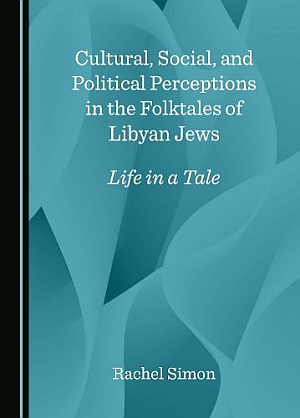
Cambridge Scholars Publishing, 2024, ISBN-13: 978-1036409685
Reviewed by Vivienne Roumani-Denn1
Do folktales provide a safer medium for transmitting lived reality, imagined worlds, or simply anthropomorphic fictions born of the human imagination? In just four chapters, Rachel Simon, a Princeton University librarian and prolific author on Mizrahi and North African Jewish history, brilliantly explores the interpersonal world of Libyan Jews through their folklore. Drawing primarily from the Israel Folktale Archives (IFA), where these tales were translated into Hebrew from Judeo-Arabic, Simon adroitly navigates the complexities of variant narratives across a structured set of thematic chapters.
She opens with "Marriage," logically starting with sections such as "Choosing a Spouse" and "Inter-Class Marriages" before diving into darker topics like "Incest," followed by lighter themes such as "Entertaining and Dining." This flows seamlessly into "Family," which features surprising sections on "Causing the Death of a Parent" and "Cross-Dressing." In "Women: His Story and Hers," Simon presents gender dynamics from dual perspectives: women as viewed by men, and women as seen by themselves. Here, women are represented as both the origin of life and the source of hardship, a humorously relatable duality that reminded me of a saying I often heard growing up in Libya, loosely translated from Judeo-Arabic: “Life is from the woman (wife), and bitterness is from the woman (wife).”
Because Simon points out the multi-ethnic nature of Libyan Jews in her introduction, I was not surprised to see the final chapter titled "We and the Other." The "Other" is a critical dimension of the North African context, where Jews, despite centuries of deep roots in Libya, existed as a minority. What delightfully surprised me, however, is that the "Other" here spans not just neighboring communities, but also supernatural beings, animals, and inanimate objects, all entirely consistent with the conventions of the folklore genre. Simon skillfully manages these nuanced categories by anchoring each chapter with its own mini-conclusion, culminating in a comprehensive final analysis at the end of the book.
Having been born in Libya and lived there during the era these tales reflect, I found myself longing for just one or two stories printed in their original Judeo-Arabic, even if only in transliteration. Growing up surrounded by these narratives, I now suspect my mother and aunts curated the more "acceptable" tales for young ears. As children, whether left to our own devices or guided subtly by our parents, we never internalized the unacceptable behaviors depicted in some of the scary stories. To us, they were simply humorous, distorted glimpses into imagined non-realities.
As the renowned UC Berkeley folklorist Alan Dundes notes (and Simon quotes in her introduction):
…The image may be distorted, but at least the distortion comes from the people, not from some outside observer armed with a range of a priori premises.2
Ultimately, folklore reveals how a community felt and understood its reality while imagining the unimaginable, offering both profound insight and great entertainment.
1 Vivienne Roumani-Denn is an oral historian, writer whose documentary films, The Last Jews of Libya and Out of Print premiered at the Tribeca Film Festival. She served as the Judaica Librarian at the University of California, Berkeley, where she created the website jewsoflibya.com, and as the Executive Director of the American Sephardi Federation at the Center for Jewish History in New York, where she founded the Sephardic Library and Archives and the Exhibition Gallery.
2 Alan Dundes, Interpreting Folklore (Bloomington & London: Indiana University Press, 1980): vii.