
Alexander Moissis
THE LOST WORLD OF HENRIETTE DE SERVIANA
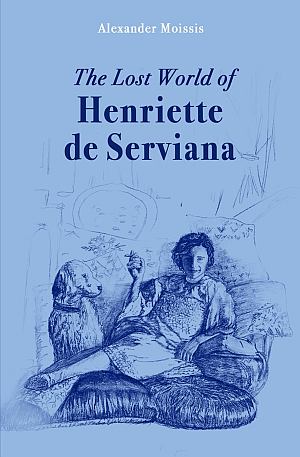
Independently Published, 2025, ISBN: 979-830760270
Reviewed by Adam J. Goldwyn1
The Romaniotes are one of, if not the, oldest diasporic Jewish community in the world, thought by scholars to have established themselves in what is now Greece and the southern Balkans before the destruction of the Second Temple in 71CE. The Romaniotes spent centuries under Hellenistic rule, then Roman rule, then Byzantine, then Ottoman, and, finally, Greek rule again under the modern Greek state as it expanded into Epirus in the early twentieth century. Despite their deep history in the southern Balkans, the Romaniotes were less well-known than their co-religionists to the north, the Ladino-speaking Sephardic community of Thessaloniki, who arrived after the expulsion from Spain in 1492.
As Alexander Moissis’ The Lost World of Henriette de Serviana indicates in the title, this millennia-old community is all but gone now: as Moissis says, “[t]his book tells the stories of the mythical Romaniote and aristocratic world of the city of Ioannina from 1905 until 1945. I call it lost because the world that she knew vanished in the Shoah” (p. 4). Indeed, the Romaniote historian Rae Dalven writes that “of the eighteen hundred and fifty Jews who lived in Ioannina in 1939, only sixty survived the Holocaust” (1973: 53).2 Fortunately, those survivors and their children and grandchildren have taken upon them the task of recuperating, recording, and reconstructing this community, especially in the past two decades through cultural institutions like the Jewish Museum of Athens and religious organizations like the Kehila Kedosha Janina Synagogue in New York City. In Greece, Romaniote synagogues, such as the Kahal Kadosh Yashan Synagogue in Ioannina, are being restored. Art and literature, particularly memoir, have also become increasingly important media for memory. Among these, women’s narratives are particularly well-represented, including the publication of two of Rae Dalven’s historical and autobiographical plays about the community, Marriages Are Arranged in Heaven (Isnafi: [1983] 2022) and A Matter of Survival (Isnafi: [1979] 2024); and Anna Kohen’s memoir Flower of Vlora: Growing up Jewish in Communist Albania (Amsterdam Publishers 2022). Beyond literature, the Berlin-based Israeli-born Romaniote visual and performance artist Adi Liraz continues to create works of memory through textiles and other media.3
The Lost World of Henriette de Serviana is another such entry, and a welcome one. Written in a style accessible to scholars and the general public alike, The Lost World blends memoir, history, family lore, and archival sources to reconstruct the world of the author’s grandmother, Hiette Moissis, née Levis, who lived from 1905 to 1996, and who adopted the fancy-sounding Francophone name when, as a teenager in the 1920s, she wrote fan-mail to French movie stars (p. 210). The Lost World is a kind of sequel to Moissis’ much-acclaimed previous work, The Nissim Levis Panorama: Stereoscopic Photos and Travels of a Doctor from Ioannina: 1898-1944 (Kapon: 2016), which features images taken by Henriette/Hiette’s uncle during his travels in Ioannina and elsewhere in Greece and Europe. The Nissim Levis Panorama may well be the single most important publication for the modern study of Romaniote history, and Moissis movingly recounts how he had played with the glass plates as a child (p. 2) and how he felt the erasure of his family’s Romaniote identity when no mention of his great-uncle’s Jewishness was made when the volume won a prestigious award from the Academy of Athens in 2017 (p. 282).
The Lost World is a work of what the scholar Maryanne Hirsch would call “postmemory,” a seminal theoretical turn in Holocaust Studies and associated fields, such as trauma studies, memory studies, and genocide studies. For Hirsch, postmemory came from “the need for a term that would describe the quality of my own relationship to my parents’ daily stories of danger and survival during the Second World War […] and the ways in which their accounts dominated my postwar childhood” (p. 4). She writes that what is
at stake is precisely the ‘guardianship’ of a traumatic personal and generational past with which some of us have a ‘living connection’, and that past’s passing into history or myth. At stake is not only a personal/familial/generational sense of ownership and protectiveness, but an evolving ethical and theoretical discussion about the workings of trauma, memory, and intergenerational acts of transfer (p. 1).
It is clear that these are the same motivations that animate Moissis’ investigation into his family’s past, both in The Nissim Levis Panorama and The Lost World. Postmemory also helps The Lost World speak beyond what might otherwise be a narrow history of his Romaniote family in the first half of the twentieth century; Moissis shares this postmemorial turn with Art Spiegelman’s Maus (1980-91), Jonathan Safran Foer’s Everything is Illuminated (2002), and Eva Hoffman’s Lost in Translation: A Life in a New Language (1990).
Moissis’ work begins in 1895 with “Three Yanniote Young Scientists in Paris” (p. 6) which traces the lives of Nissim, Sam, and Maurice Levis, as Moissis calls them “three brothers, three different paths” (p. 12). The last decade of the nineteenth and the first decade of the twentieth centuries was a period of great turbulence among the Romaniote community, with emigration taking almost half of the city’s four to five thousand Romaniotes, and the wealthiest half, out of Ioannina, with the majority going to New York.4 The Levis brothers represent an elite among this diasporic movement, traveling back and forth between Ioannina, Paris, and elsewhere around Europe. Hiette herself traveled as a child, and photos from the book accompany a narration of her visit with her family to Venice and through Switzerland (pp. 171-175).
It is in reconstructing these glimpses of pre-war Romaniote life that the book is at its strongest. While long sections deal with the general history of Ioannina and larger geopolitical currents shaping Greek history, Moissis’ ability to show his grandmother’s life in its ordinary and extraordinary moments are the emotional center of the book, the titular “lost world” that Hiette carried with her and that, now, only Moissis can share. In reconstructing how his grandmother might have experienced the consequences of great power rivalries after the First World War on a personal level, Moissis writes of the Treaty of Sèvres, which dismantled the Ottoman Empire and parceled its holdings out to the victorious European powers:
Let’s forget for a moment what followed. Erase from your mind Greece’s military catastrophe in Asia Minor, the persecutions, torture, and killings, the forced migration and separation of families, the population exchange, the suffering of refugees, the trials and executions. The only thing that the people of Ioannina saw before them on the afternoon of July 30 was an agreement that crowned the Greek Army’s rapid conquests with the approval of the great powers (p. 183).
Such a framing is both powerful and necessary; when the Crown Prince Constantine entered Ioannina having conquered Epirus from the Ottomans on February 20, 1913, and dined with the Levis family, including young Hiette, then seven; none of them could know that, just over two weeks later, the Crown Prince would have to
depart … urgently for Athens upon learning that his father, King George I, had been assassinated in Thessaloniki. The news reached him while he was staying at the home of former mayor Christakis Sakellarios near the Zosimaia School (p. 85).
The young Hiette did not know her community would be destroyed two decades later, and so she did not experience her life then in a way we do retroactively in the last decades before the end of the Holocaust.
Thus, though Moissis is right to remind us that his ancestors did not live their lives knowing how it would end, the Holocaust itself forms the silent background for all the stories. A photograph of the 1937 wedding of Aliki Levis and Isaak Batis underscores the scope of the tragedy that befell the Romaniotes; eighteen of the twenty five people in the photo died during the Holocaust. Three had died before the Holocaust, and only four of the group were still alive seven years later (p. 232). Moissis identifies each by name and, where possible, how they died:
Iossif Peppo Batis, assassinated by the Germans on the road to Kladorahi, Florina, in 1943; Nissim Batis, the groom’s father, hanged by the Germans in Kladorahi, Florina, in 1943; Nissim Levis, the photographer who documented “the lost world,” presumably in Auschwitz (pp. 232-233).
Hiette and her immediate family survived in hiding, much like the Cretan-Jewish poet Iossif Ventura and the Cohen family, protagonists of Rae Dalven’s A Matter of Survival.
Moissis’ position as a second-generation writer of postmemory Holocaust witness comes through most clearly in these concluding chapters, where some of his own autobiography enters the narrative:
The discovery of deportation photographs in German archives added another haunting dimension: the images of the truck convoy carrying my ancestors and 2,000 other Ioannina Jews through the cold. As an engineer working in business process automation, I found myself analyzing the logistics of this horrific mass deportation (p. 255).
Moissis then walks us through these logistics as he imagines them:
Simple calculations reveal the scale of the operation: transporting 2,000 people would have required between 100 and 200 trucks. Each truck measured just over 6 meters in length, and assuming 5 meters between vehicles, a convoy of 100 trucks would stretch more than 1,100 meters. With 200 trucks, the line would reach nearly two kilometers (p. 255).
A second-generation writer, Moissis is still processing the horrors of events nearly eighty years ago: “The image of this convoy haunts me. I wonder: were my relatives transported in an open truck through the snowy Katara passage, or in a covered vehicle?” (p. 259). Even at the distance of generations, and even knowing how their lives ended, Moissis still wishes that they were at least warm as they were sent to their deaths.
The book’s great strength is how it recuperates the lost history of Ioannina and the Romaniotes by restoring the humanity to the pictures of crowds of deportees that have become all too familiar to those with even a passing knowledge of the Holocaust. Moissis and other historians and memoirists of the Romaniotes also understand that the stories of the few survivors also deserve memorialization, and perhaps none more than Moisis Elisaf, the son of Holocaust survivors who became perhaps the most prominent Jew in Greece, culminating in his election to the mayoralty of Ioannina from 2019 to his death in 2023. “He inspired in me and in many others,” writes Moissis, “a sense of duty to continue contributing, each in our own way, to the prosperity of our ancestors’ beloved homeland” (p. 285). The Lost World of Henriette de Serviana is a deeply personal work of second-generation Holocaust memory embedded in broad currents of great power rivalry and global conflict; it is the story of the men and women who died in the Holocaust and the millennia-old culture that died with them. But it is also a story of survival and resilience. Shortly before his death, the Italian survivor and memoirist Primo Levi wrote that “the entire history of the brief ‘millennial Reich’ can be reread as a war against memory, an Orwellian falsification of memory, falsification of reality, negation of reality.”5 The Nazi military campaign of conquest in the Second World War has long since ended, but the Nazi war against memory continues; lives like those lived by Moisis Elisaf and books like those by Alexander Moissis are powerful refutations of this second, longer, campaign.
1 Adam J. Goldwyn is Professor of English at North Dakota State University. He is the author of, most recently, Homer, Humanism, Holocaust: Jewish Responses to the Crisis of Enlightenment During World War II (Palgrave Macmillan, 2022) and Zero Generation Holocaust Literature and the Art of Non-Survival (Palgrave Macmillan, 2025).
2 Dalven, Rae. “Betrothal and Marriage Customs of the Jannina Jews.”Sephardic Scholar 3 (1973): 41-61, 53. Estimates of the numbers vary; Annette Fromm estimates about 200 (p. 18). While the exact numbers may be subject to dispute, by any reckoning some 95-99% of the population died (We Are Few: Folklore and Ethnic Identity of the Jewish Community of Ioannina, Greece. Bloomsbury Academic).
3 https://adi-liraz.squarespace.com/
4 Fromm, 14. Fromm cautions against certainty in population figures, noting that figures varied widely (pp. 8-9).
5 Primo Levi, The Drowned and the Saved, trans. Raymond Rosenthal (New York: Vintage, 1989), 21.