
Return Through the Secret Passage
Doña Gracia Mendes Nasi
Between Law, Memory, and Identity1
By Rifka Epstein2
Abstract
More than five centuries after her death, Doña Gracia Mendes Nasi stands at the threshold between concealment and return. Born into a world shaped by forced conversion and fragile identities, she navigated the uncertain passage between public conformity and private memory. Her life unfolded within the complex reality of converso existence, where Jewish continuity depended on the ability to move between visible and hidden worlds.
This article revisits her historical significance through the lens of Responsum #80 written by Rabbi Moses (Moshe) ben Joseph Mitrani (the Mabit), which offers rare legal insight into the challenges faced by conversos seeking to reclaim Jewish identity in the sixteenth century. Placing this responsum in dialogue with Doña Gracia’s leadership and with the later cultural reflection found in the film The Secret Passage, the study explores the intersection of law, memory, and identity in processes of return after forced concealment. It reveals Doña Gracia not only as a historical figure but also as part of a broader continuum of Crypto-Jewish restoration.
By situating this responsum within the wider context of Sephardic resettlement, the article demonstrates how rabbinic legal sources illuminate the social and familial realities of Jewish reconstitution after generations of forced conversion, highlighting Doña Gracia’s role both as a public leader and as a figure embedded in the intimate legal struggles of return.
Introduction
I approached the Responsum as key to flesh out the real-life challenges of the anusim3. Only gradually have I come to recognize its broader significance. Through its legal reasoning, the responsum illuminated the complex legal realities faced by anusim’s families whose most intimate decisions—marriage, property, and inheritance—had been shaped within Christian society,4 yet could later come under the jurisdiction of Jewish law.
This specific responsum offers a rare window into the lived experiences of converso families connected to Doña Gracia Mendes Nasi, whose leadership would later play a central role in the reestablishment of Jewish life across the Sephardic diaspora. Through the legal voice of the Mabit, the document preserves the traces of a family negotiating continuity across rupture and reveals how Jewish law functioned not only as a system of rules, but as a framework through which converso families could confront the legal and personal consequences of their past.
From Beatriz de Luna to Doña Gracia Nasi: Reclaiming Jewish Identity in Ferrara
Born in Lisbon in 1510 as Beatriz de Luna, Doña Gracia Nasi came from a family of conversos whose public Christian identity concealed a Jewish heritage shaped by persecution, adaptation, and resilience. Like many descendants of the Jews forcibly converted at the end of the fifteenth century, her family lived within the fragile balance between outward conformity and inherited memory. Their Christian identity offered social protection, yet it coexisted with a consciousness of Jewish origins that could neither be openly expressed nor entirely erased.
Her marriage to Francisco Mendes, a prominent merchant and member of one of the most influential converso banking families in Europe, placed her within commercial and diplomatic networks that stretched across Portugal, Antwerp, and beyond. These connections would later prove essential not only for economic success but also for the rescue and relocation of conversos fleeing the Iberian Peninsula. Following her husband’s death and amid the growing pressures of the Portuguese Inquisition, Beatriz assumed control of the family’s extensive financial affairs, an extraordinary responsibility for a woman in sixteenth-century Europe.
Her departure from Portugal initiated a gradual process through which the Jewish identity preserved in secret within her family became publicly visible. After periods in Antwerp and Venice, she arrived in Ferrara in 1549 under the protection of Duke Ercole II d’Este. Ferrara had become an important refuge for Sephardic exiles, offering a rare environment in which former conversos could openly reclaim their Jewish identity.
It was in Ferrara that Beatriz de Luna publicly embraced the name Doña Gracia Nasi and entered the flourishing Sephardic community. Although no contemporary source describes a formal ceremony marking her return to Judaism, her transformation became evident through a series of public actions that reflected her renewed religious and communal identity. As the historian Cecil Roth observed, “Ferrara was Gracia’s intellectual birthplace.” There she emerged as one of the leading patrons of Sephardic Jewish life, establishing close relationships with prominent members of the community, including Benvenida Abravanel, whose friendship reflects the vibrant intellectual and communal environment that characterized the city.
Doña Gracia’s commitment to Jewish renewal was expressed not merely through a change of name but through sustained communal leadership. She continued financing networks that enabled conversos to escape the Iberian Peninsula while supporting Hebrew and Judeo-Spanish publications intended to reconnect former conversos with Jewish learning and practice. Among her most enduring contributions was her patronage of the Ferrara Bible (1553), one edition of which was dedicated to her in recognition of her support for Jewish scholarship. By making the Hebrew Scriptures available in Spanish, the Ferrara Bible enabled many former conversos—who no longer possessed sufficient knowledge of Hebrew—to rediscover the foundations of their ancestral faith and observe Shabbat and the Jewish festivals according to Jewish tradition.
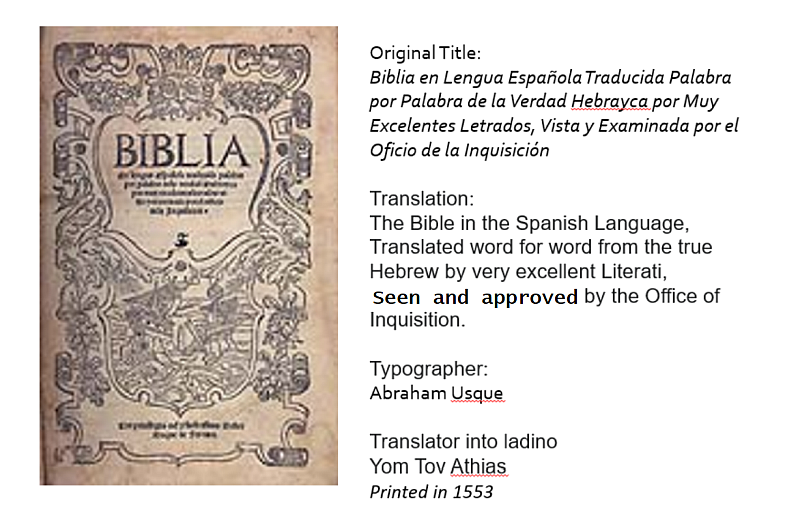
Title page of the one edition of the Ferrara Bible (1553).
This was dedicated to Duke Ercole II d’Este,
whose protection transformed Ferrara into a refuge for Sephardic exiles.
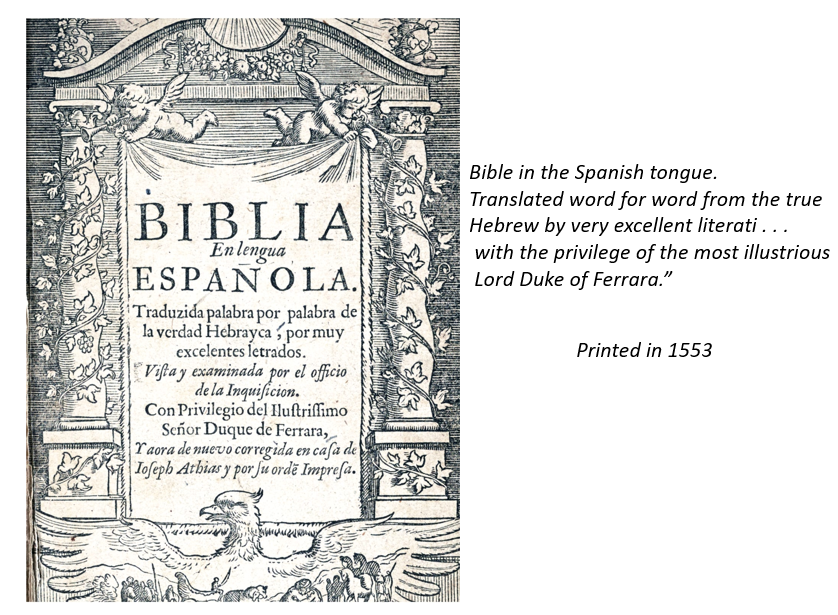
This edition was dedicated to Doña Gracia Nasi
in recognition of her patronage of Jewish scholarship
and her contribution to the religious and cultural renewal of the Sephardic community.
Together, the two editions symbolize the partnership between political protection and Jewish leadership that made possible the reemergence of openly Jewish life in Ferrara.
Unlike Doña Gracia, whose life increasingly reflected an openly Jewish identity, her younger sister Brianda chose to remain within the Christian world. Their differing religious paths, together with disputes over family property and the guardianship of Brianda’s daughter Reyna, eventually led to a bitter legal conflict. Their story illustrates the personal, familial, and religious tensions experienced by many converso families as they navigated the uncertain path between concealment and return.
The contrasting choices made by Doña Gracia and Brianda demonstrate that there was no single path back to Judaism. Some conversos embraced an openly Jewish life when circumstances permitted, while others remained within the Christian world because of family obligations, economic realities, or personal conviction. These experiences provide an important historical framework for understanding the legal questions addressed in Rabbi Joseph ben Moses Mitrani’s Responsum 80.
Doña Gracia’s experience was not unique. Across sixteenth-century Europe, conversos confronted difficult questions concerning marriage, inheritance, communal membership, and religious reintegration after returning to Judaism. These practical and legal dilemmas found expression in rabbinic responsa, including the case examined by Rabbi Mitrani. Within this broader historical context, Responsum 80 may be read not merely as a legal ruling but as a window into the lived realities of converso families negotiating the complex passage from concealment to open Jewish life.
Responsum 80: A Halakhic Mirror of Converso Life
The historical experiences described in the previous section find their legal counterpart in Responsum 80 of Rabbi Moshe ben Yosef di Trani (the Mabit). Like Doña Gracia Mendes Nasi and countless other conversos who sought to reclaim their Jewish identity, the individuals who appear in this responsum were navigating the complex transition from life as New Christians to renewed participation in the Jewish community. The responsum therefore belongs not only to the history of Jewish law but also to the broader history of converso reintegration in the sixteenth-century Sephardic world.
In addressing this case, Rabbi Mitrani confronted a reality familiar to many rabbinic authorities of the early modern Sephardic diaspora: the need to evaluate marriages, contracts, and financial obligations formed under Christian legal systems. His discussion reflects the broader halakhic principle of dina de-malkhuta dina (דינא דמלכותא דינא), “the law of the kingdom is the law,” which recognizes the legal authority of civil law in matters of property and financial obligation. For converso families whose lives had long been shaped by exile, coercion, and displacement, this principle enabled rabbinic courts to engage with legal arrangements established outside the framework of Jewish communal life.
The question before Rabbi Mitrani extended far beyond technical legal procedure. He was required to determine whether a marriage contracted under the civil law of the country between two anusim could be recognized under Jewish law and how the couple’s legal status should be understood after their return to Judaism. His analysis established halakhic principles with the extraordinary circumstances created by forced conversion. The issue was not whether Jewish identity could be created anew, but how it should be recognized after years of enforced interruption. In doing so, the responsum affirmed that forced conversion had not severed the essential bond between the individual and the Jewish people.
Although the responsum addresses a specific legal dispute, its implications reach well beyond the individuals involved. It reflects a broader historical moment in which conversos across Europe and the Ottoman world struggled to reconcile civil obligations inherited from their Christian lives with their renewed participation in Jewish communal life. Read within this historical framework, Responsum 80 functions as more than a legal ruling; it becomes a window into the lived realities of converso families negotiating the passage from concealment to restoration.
What makes Responsum 80 particularly remarkable, however, is not only its legal reasoning but also what it preserves. Rather than merely summarizing the case before him, Rabbi Mitrani reproduces portions of the original legal document בלשון לעז (belashon la’az, “in the vernacular spoken by the parties”), preserving its wording instead of translating or paraphrasing it into Hebrew. As a result, the responsum preserves not only a halakhic discussion but also fragments of a sixteenth-century legal document that offers a rare glimpse into the language, legal culture, and lived experience of Iberian conversos.
The Voices Preserved Within the Responsum
The reproduced clauses constitute one of the most distinctive features of Responsum 80. Embedded within Rabbi Mitrani’s legal analysis is a contemporary legal document preserved in the language in which it was originally drafted. Rather than quoting isolated phrases, the Mabit copied substantial portions of the document, allowing modern readers to encounter not only the legal language used by converso families but also the voices of individuals negotiating marriage, inheritance, and family relationships in the aftermath of forced conversion. These passages preserve not only evidence of legal practice but also traces of the linguistic and cultural world inhabited by former conversos.
Because the Mabit chose to reproduce the document in its original wording rather than translate or paraphrase it into Hebrew, the responsum offers an unusual opportunity to examine a sixteenth-century legal text through both halakhic and historical lenses. The excerpts illuminate questions of family relationships, inheritance, guardianship, and legal authority while simultaneously revealing the continued use of the vernacular within converso legal culture. Read in this way, the responsum becomes more than a legal decision; it also serves as a historical archive preserving voices that might otherwise have been lost.
The following excerpts are presented first in the original Hebrew transcription and then in my English translation, following the order in which they appear in the responsum.
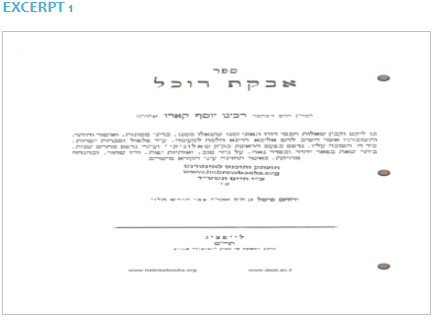
First page of the book Avkat Rochel
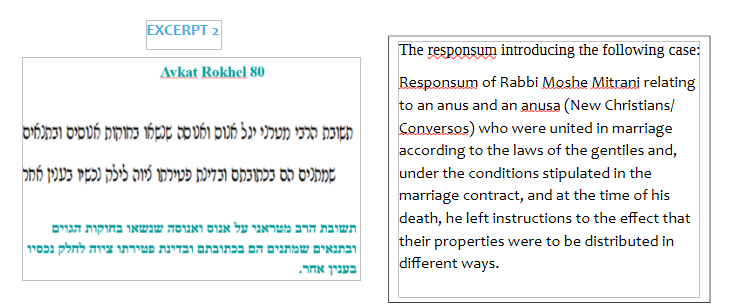
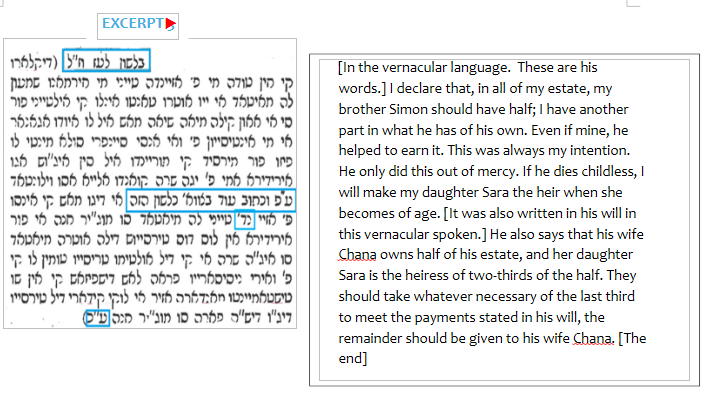
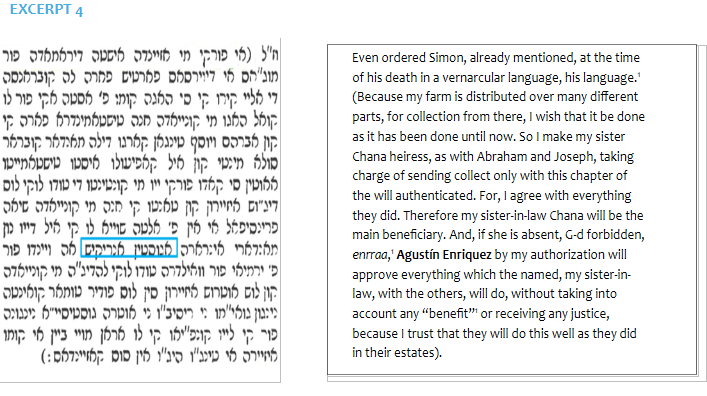
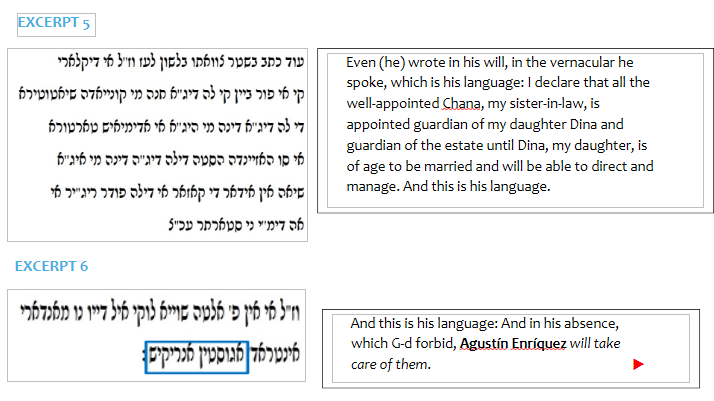
Collectively, these excerpts illustrate the unusual documentary character of Avkat Rochel 80. The responsum does not merely refer to a legal document written in the vernacular; it preserves portions of that document within the Hebrew text, allowing the voices and legal language of sixteenth-century anusim to remain visible in the rabbinic record.
Cultural Memory and Representation
The Secret Passage
A film directed by Ademir Kenovič (2004)

The historical realities reflected in Rabbi Mitrani’s responsum and embodied in the life of Doña Gracia Mendes Nasi did not disappear with the passage of time. Instead, they persisted in cultural memory, finding expression in later narratives that sought to reconstruct the converso experience. Among these representations, the film The Secret Passage offers a modern interpretation of the fragile and often perilous transition from concealment to return.
Set in the sixteenth century, the film dramatizes the experiences of conversos who attempt to reclaim Jewish identity while navigating the social, religious, and political dangers that continued to define their world. Its narrative centers on the tension between outward conformity and inner continuity — a tension that mirrors the historical realities preserved in rabbinic responsa such as the one we are working on by Rabbi Mitrani. The film’s portrayal of secrecy, surveillance, and cautious self-disclosure reflects the conditions under which Jewish identity was not abandoned but strategically concealed. It evokes a Jewish past shaped by coercion and adaptation.5
While cinematic representation necessarily simplifies historical complexity, its emotional framework captures an essential truth: return was not a single moment of declaration, but a gradual and uncertain process. Individuals emerging from generations of forced conversion faced not only external obstacles, but internal questions of belonging, legitimacy, and recognition. These were precisely the questions addressed within Halakhic discourse. In this sense, the film does not merely dramatize history; it echoes the legal and existential dilemmas that figures such as Doña Gracia and her contemporaries confronted.
At the same time, the film highlights the role of memory in shaping historical understanding. By transforming archival realities into narrative form, it participates in the ongoing effort to give voice to experiences that were often deliberately silenced. Cultural representation thus becomes another medium through which the passage between concealment and return did not close with her life time.
Seen in this light, The Secret Passage functions not as a substitute for historical or legal sources, but as their cultural counterpart. Where the responsum records the legal recognition of return, and Doña Gracia’s life (here known as Isabela Benveniste), her sister known as Clara and her niece Victoria) embodies its historical enactment, the film reflects its enduring presence in collective memory. Together, these layers reveal the continuity of a process that extends beyond any single individual or century: the persistent effort to reclaim identity after its forced interruption.
The Secret Passage should not be seen or interpreted as a direct representation of Doña Gracia Mendes Nasi’s life. The film does not attempt to reconstruct her biography. Rather, its portrayal of converso experience captures structural realities — secrecy, danger, and the uncertain process of return — that defined the historical world she inhabited.
These scenes from The Secret Passage visually evoke the atmosphere of fear, surveillance, and divided loyalties that shaped converso life. Through cinematic representation, they give visual form to the tensions between persecution, secrecy, and the preservation of Jewish identity.
The dialogue among the responsum, history, biography, and cinema reminds us that the story of the conversos survives not only in legal texts but also in the collective memory preserved through cultural representation. Together, these complementary perspectives illuminate the enduring human journey of identity, resilience, and return.
Doña Gracia and the Meaning of Return
The life of Doña Gracia Mendes Nasi reveals that return was not a single act, but a process shaped by time, circumstance, and negotiation. Her transition from Beatriz de Luna, a converso living under the constraints of Christian identity, to Gracia Nasi, — later known among Ottoman Jewry as La Señora (Ha Geveret)6 — an openly Jewish leader, illustrates the gradual restoration of a continuity that had never been fully extinguished. This transformation did not occur simply through personal conviction, but through movement across geographic, legal, and social boundaries that made such restoration possible. After settling in the Ottoman Empire, this restoration became visible through concrete communal actions. Around 1554–1555, Doña Gracia established and endowed a Spanish yeshivah in Constantinople, appointing the distinguished halakhic authority Rabbi Joseph ibn Lev7 as its Rosh Yeshiva. In the introductions to his published responsa, Rabbi ibn Lev himself acknowledges that the academy and its scholars were sustained through the patronage of “La Señora,” Doña Gracia Nasi. Her support extended beyond her own return to Judaism; by strengthening institutions of Torah learning and communal life, she helped create an environment in which other conversos could reclaim their Jewish identity openly.
Her experience reflects the broader reality faced by conversos throughout the early modern world. Return required more than belief; it required recognition — recognition by Jewish communities, by rabbinic authorities, and by the individuals themselves. It was within this framework that legal texts such as Responsum #80 assumed their full significance. The responsum did not create Jewish identity but acknowledged its persistence beneath enforced concealment. In this sense, Halakhah functioned not as an instrument of conversion, but as a mechanism of restoration.
Doña Gracia’s life also demonstrates that return carried communal implications. Her efforts extended beyond her own family to include the support and protection of other conversos seeking similar restoration. Through her financial resources, political influence, and personal commitment, she contributed to the reestablishment of Jewish life for individuals whose identities had been publicly denied for generations. Her actions transformed private memory into collective renewal.
Seen within a longer historical perspective, her experience marks an early point in a continuum that would unfold across centuries. The challenges she confronted — concealment, negotiation, and the search for recognition — would reappear in later figures navigating similar passages between hidden and open Jewish identity. Her life thus stands not only as an individual story, but as part of an enduring historical process: the gradual and often fragile return of Jews whose connection to their heritage had survived despite sustained efforts to erase it.
Return, in this context, was neither immediate nor complete. It unfolded unevenly, shaped by legal frameworks, cultural memory, and historical opportunity. Doña Gracia Mendes Nasi stands among the first to navigate this passage successfully, demonstrating that identity interrupted by force could, under the right conditions, reemerge and endure.
Conclusion
The life of Doña Gracia Mendes Nasi, the legal reasoning of the Mabit, and the later cultural reflection found in The Secret Passage together illuminate a single historical reality: the persistence of Jewish identity despite its forced concealment. Each, in its own form, preserves a moment within the passage between interruption and restoration. Law gave it recognition. Life gave it expression. Memory ensured its survival.
Read in its historical context, Responsum 80 is more than a legal ruling about marriage or property. It is a historical archive that preserves human lives. When read alongside historical sources, rabbinic responsa reveal not only the development of Jewish law but also the resilience, choices, and lived experiences of the communities they served.
Seen across the centuries, her experience stands at the beginning of a longer continuum. The challenges she confronted would reemerge in later generations, as descendants of forced converts sought once again to reconcile inherited memory with lived identity. The passage between concealment and return did not close with her lifetime. It remained open, shaped by new historical circumstances and new acts of restoration.
In this sense, the secret passage of the conversos was never entirely secret. It persisted in legal texts, in institutions of Jewish learning, in individual lives, and in collective memory. Doña Gracia Mendes Nasi stands among the first to navigate it openly, transforming concealment into return and memory into continuity. Her story reminds us that the journey from concealment to return is not a single event, but an ongoing historical process, inviting each generation to recover, preserve and transmit the memory entrusted to it 8.
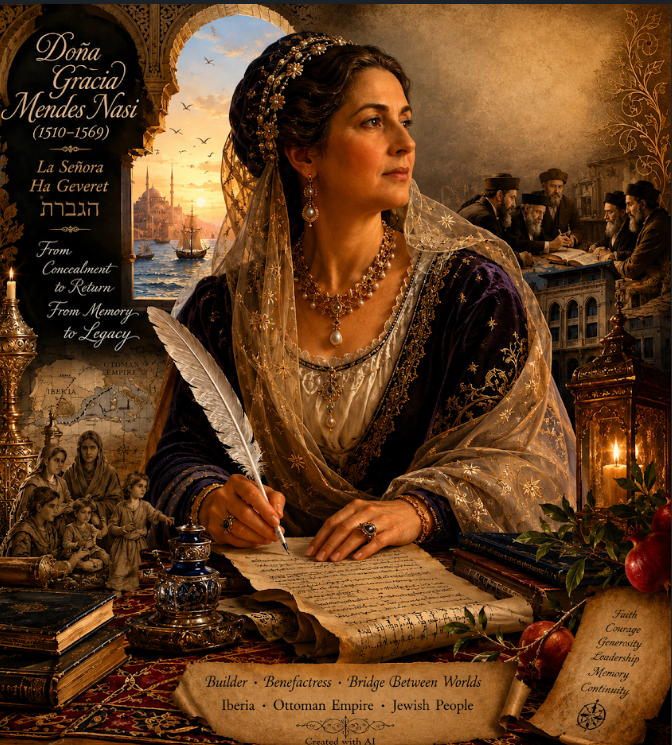
Rather than reconstructing the historical appearance of Doña Gracia Mendes Nasi, this contemporary artistic interpretation seeks to capture her legacy. The composition reflects the central themes explored in this article—identity, memory, resilience, scholarship, and communal renewal—presenting her as a symbol of the passage from concealment to return. Like the responsum examined in this study, the portrait invites us to look beyond historical events and consider the human lives, choices, and enduring legacy they preserve. Image created with the assistance of artificial intelligence.
1 An earlier version of this study was published under the name Rifka Cook in Judeo-Spanish and the Making of a Community (Cambridge Scholars Publishing, 2015). Reprinted and expanded with permission.
2 Rifka Epstein is an educator, researcher and professor emerita whose work explores hidden Jewish identities in Latin America, especially Crypto-Jewish traditions passed down through food, ritual, and storytelling. With five decades of teaching experience in Venezuela, the U.S. and Israel, she combines scholarship, technology, and intercultural dialogue to connect learners across generations and borders. She continues to share her work through lectures, community projects, and virtual storytelling from her home in Beit Shemesh, Israel.
3 Anusim (singular masculine: anus; singular feminine: anusa) Jews who were forced to convert to Christianity in Spain and Portugal but who secretly kept elements of their Jewish belief, practice, identity, and collective memory despite the constant threat of persecution by the Inquisition.
4 The term “Christian society” refers to the Catholic-dominated legal and social order of sixteenth-century Venice, whose institutions and civic structure were defined by Christian norms, within which Jews held a distinct legal status. See Brian Pullan, The Jews of Europe and the Inquisition of Venice, 1550–1670 (Oxford: Basil Blackwell, 1983).
5 Cecil Roth, Doña Gracia of the House of Nasi (Philadelphia: Jewish Publication Society, 1948).
6 Cecil Roth, Doña Gracia of the House of Nasi (Philadelphia: Jewish Publication Society, 1948), 176–178. Roth notes that within the Ottoman Sephardic world she was widely known as La Señora and recognized as a leading female patron and communal authority. See also Jane S. Gerber, The Jews of Spain: A History of the Sephardic Experience (New York: Free Press, 1992), 189–192.
7 For Rabbi Joseph Ibn Lev’s acknowledgment of Doña Gracia’s patronage of Constantinople Yeshivah see https://www.posenlibrary.com/author/joseph-ibn-lev.
8 For readers interested in exploring further the life and historical significance of Doña Gracia Mendes Nasi and the converso experience, the following works provide valuable perspectives:
Adelman, Howard Tzvi. "The Venetian Identities of Beatrice and Brianda de Luna." Nashim: A Journal of Jewish Women's Studies & Gender Issues, no. 25 (Fall 2013): 10–29. Accessed July 2, 2026.
Bénard, Andria. La Dona Gracia Nasi. Paris: Éditions du Rocher, 1992.
Birnbaum, Marianna. The Long Journey of Gracia Mendes. CEU Press. Central European University Press. Budapest. New York, 2003.
Brooks, Andrée Aelion. The Woman Who Defied Kings: The life and times of Doña Gracia Nasi. Paragon House. Minnesota, 2002.
Roth, Cecil. Doña Gracia of the House of Nasi. Philadelphia: Jewish Publication Society, 1948.
Frank, Laura Shaw. "Power, Politics and Personal Connections: Dona Gracia’s Inheritance, Rabbi Joseph ibn Lev, and the Law." Seminar paper for HIST 619A, Dr. Bernard Cooperman, University of Maryland, June 2013. Accessed July 2, 2026.
Gerber, Jane S. The Jews of Spain: A History of the Sephardic Experience. New York: Free Press, 1992.
Kaplan, Yosef. An Alternative Path to Modernity: The Sephardi Diaspora in Western Europe. Leiden: Brill, 2000.
Ragen, Naomi. The Ghost of Hannah Mendes. St. Martin's Griffin, New York. 1998.
Yerushalmi, Yosef Hayim. From Spanish Court to Italian Ghetto: Isaac Cardoso. Seattle: University of Washington Press, 1971.